
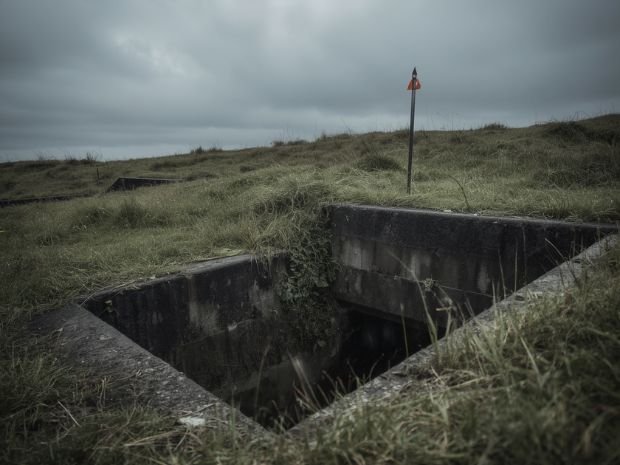
Call it the Maginot Effect. By preparing for a repeat of WWI to also take place during WWII, France suffered a humiliating defeat during the months of May and June in 1940 (more on this below). Said differently, the Maginot Effect ties deeply into the human tendency of institutions, nations, and military establishments to prepare brilliantly for the last war while the next one quietly reinvents itself around them. Importantly, this notion based on almost century old history still exists today as evidenced by two of the world’s military superpowers being stymied in Ukraine and Iran due to newly emerged drone technology and strategy connected to it.
But what happens next when superpowers who have nuclear armaments can’t achieve their geopolitical objectives by conventional military means ? This question shouldn’t be taken lightly as US intelligence (see below) assigned a 50% chance that Russia would use some form of nuclear weapons to counter Ukrainian military advances in strategically important Crimea in 2022. While thankfully this action didn’t occur, the specter of this threat raises a question as to whether Israel’s militarily hawkish Prime Minister, Benjamin Netanyahu, would have already used similar nuclear weapons on Iran if Iran weren’t the ally of China, another nuclear superpower?
The Lesson France Didn’t Learn
To better understand current military events, it becomes necessary to draw on history.
The First World War ended in November 1918 with an important revelation. After four years of catastrophic stalemate in the trenches of the Western Front; years in which millions died for the gain of a few miles, Allied commanders discovered a formula for breaking the deadlock. Surprise, combined with the shock power of newly unleashed tank formations, achieved in weeks what years of attrition had failed to produce. Germany’s army, who was caught on the wrong side of this tactical revolution, collapsed and blamed their defeat on their country’s citizen base who “stabbed them in the back”.
But away from this internal and convenient juxtaposition to explain a failed war effort, Germany absorbed this painful lesson and rebuilt its prospective military doctrine around it. The result, two decades later, was Blitzkrieg; fast, combined-arms warfare that weaponized exactly the kind of armored surprise that had defeated Germany in 1918. France, meanwhile, drew the opposite conclusion. Convinced that the defining feature of the next war would be the trench warfare of the last one, France constructed the Maginot Line; an engineering marvel but also fatally a monument to the wrong idea. When the German army approached France in 1940 after punching through the Ardennes Forest, they delivered a precise armor led surprise that France had failed to anticipate. France fell in six weeks. Importantly, the Maginot Line didn’t fail because it was poorly built. It failed because it was perfectly designed for a war that happened twenty years before.
Ukraine, Drones, and the New Stalemate
Fast forward to the present, and striking parallels exist today relative to the reasons behind France’s epic failure in 1940.
Consider that the war in Ukraine has, in many respects, recapitulated the dynamic of World War One’s Western Front. What began as a war of rapid movement ultimately became bogged down into a grinding, attritional conflict where territorial gains began to be measured in kilometers and paid for at an enormous human cost. The culprit for such stalemate, as was the case in 1914-1918, has been technology that has made defense dramatically easier than offense. Except this time, the technology isn’t barbed wire and machine guns. It’s drones.
Rob Lee, a leading military analyst and senior fellow at the Foreign Policy Research Institute who has spent significant time on the front lines in Ukraine, has documented this shift with granular precision. In his conversations with Ukrainian battalion and brigade commanders, Lee found that an estimated 80% of casualties, with a range running as high as 95%, are now caused by unmanned aerial systems. Artillery and drones have become so complementary, so omnipresent, that the modern battlefield has become a near-prohibitive environment for the kind of massed conventional movement that defined 20th century warfare.
This has led some military analysts to ask whether the tank, the weapon that broke the stalemate of World War One and defined the warfare of World War Two, had become obsolete in the drone age. But Lee and others push back on this conclusion, and their counterargument is historically resonant. The answer, they suggest, is not to abandon the tank but to combine it intelligently with drone technology. Through this lens “pockets of superiority” could be achieved (in theory) by disrupting enemy drone operations at a specific place and time which could then open a window for conventional armor to exploit the breach. In other words: the same formula that worked for the allies in 1918 could be updated to achieve success today.
The irony here is obvious from an historic perspective. The solution to a drone-induced stalemate, for example, may be a doctrine that looks remarkably like the one that ended the last great stalemate; a combined armaments surprise, but reimagined for a new era.
The American Maginot Line
Why the analysis above matters today brings us to the uncomfortable question of where does the United States reside within a world experiencing global military disruption ?
General Matt Van Wagenen, a retired two-star US Army general and former Deputy Chief of Staff for Operations at NATO’s Supreme Headquarters Allied Powers Europe, has been admirably direct on this point. His assessment of American military procurement is a warning dressed in plain language: the US military risks investing in yesterday’s technology at precisely the moment when the battlefield is being reinvented beneath its feet. Military formations of the future, in his view, will be largely unmanned and the American military isn’t moving fast enough in that direction.
Some good news does exist on this front of newly introduced military uncertainty for the US as the Pentagon has in conjunction with the Trump administration’s fiscal 2027 budget request is I the process of allocating more than $70 billion for military drones and counter-drone systems. While some call this new direction in military spending as one of the largest such investments in US military history, the speed of this pivot is an acknowledgment of how much ground has already been lost by the US in confronting today’s battlefield. As one senior defense official noted, drone technology is now evolving “in a timeframe of weeks, not the typical years that we see with our defense production.” That gap between the pace of technological change and the pace of institutional adaptation is, in essence, a Maginot Line being built in real time.
The evidence from recent conflicts is sobering. Two of the world’s preeminent military superpowers; the United States and Russia, have found themselves stalemated or outmaneuvered by technologically asymmetric opponents. Russia, with one of the world’s largest conventional militaries, has been unable to achieve decisive victory against Ukraine, a nation a fraction of its size and military budget. The US, in the broader context of the Iran conflict, has encountered the uncomfortable reality that drone saturation and distributed warfare can neutralize advantages that once seemed insurmountable. The playing field has been leveled, in other words, because of $300 drones achieving success against million-dollar assets.
This quandary faced by Russia and the US today is not unique when considered through secular military history. A Maginot dynamic is again playing out that runs counter to arrogant assumptions that existing geopolitical advantages are durable based on a dangerous assumption that the technology and doctrine that produced past victories will produce future ones. This notion, after all requires that your adversary will be obliging enough to fight the war you prepared for…
The Nuclear Shadow
It is here is where the stakes can escalate from the strategic embarrassment that exists for suddenly stymied superpowers to one of existential risk.
When conventional military dominance erodes, when the gap between a superpower’s expectations and its battlefield reality widens, the temptation to reach for nuclear options grows. This is not theoretical. It has already happened, at least in the realm of calculation.
In autumn 2022, as Ukrainian forces threatened to collapse Russian lines and potentially march toward Crimea, US intelligence corroborated the seriousness of Russia’s nuclear warnings, and National Security Adviser Jake Sullivan subsequently characterized the likelihood of Russian nuclear use as a “coin flip” in response to a conventional military setback. The Biden administration issued urgent private warnings to Moscow, and the crisis passed; but the lesson it left behind is ominous. As analysts have noted, “the norm against the use of nuclear weapons is fragile,” and in any direct NATO-Russia conflict “the nuclear risk would be even higher.” Foreign AffairsRussia Matters
The logic of nuclear deterrence has always rested on a degree of rational predictability. Nations with nuclear weapons would not use them because the consequences of doing so were suicidal. Mutually Assured Destruction kept the peace; imperfectly, anxiously, but effectively…for decades. What the Ukraine conflict has revealed is how thin that predictability can become when a nuclear power feels its conventional military position is humiliated or existentially threatened.
Iran has been watching all of this tragic theater carefully. Tehran understands very well a set of lessons that the post-Cold War world has taught with brutal clarity. A rogue state such as North Korea, which possesses nuclear weapons, has essentially been left alone by the international community, however provocative its behavior ha been. Israel, which possesses nuclear weapons, operates with a strategic freedom that non-nuclear states cannot match. In contrast, Saddam Hussein’s Iraq, which did not possess nuclear weapons when the US decided to act against it, no longer exists as a state. The conclusion any rational Iranian strategic planner draws from this data set is obvious and makes a durable, verifiable peace agreement between the US and Iran extraordinarily difficult to achieve. Iran’s close relationship with China, a full nuclear power, adds another layer of complexity to any negotiated settlement.
The New Calculus
The geopolitical world that emerged from World War Two was, for all its tensions and proxy conflicts, characterized by a certain terrible stability. Two superpowers, each rational enough to understand the consequences of nuclear war, managed a dangerous but broadly predictable balance. The rules, though never written in any treaty, were broadly understood.
That world is gone.
The superpowers that anchored it have become less predictable. The technology that once gave them overwhelming conventional superiority has been democratized; distributed to smaller actors at a cost measured in hundreds of dollars rather than billions. The drone has done to military power what the internet did to information; it has made it radically accessible, and in doing so has upended hierarchies that seemed permanent.
France thought its Maginot Line was impregnable. It was. The Germans simply went around it.
The question the world must now urgently grapple with is this: as old military orthodoxies crumble under the weight of technological change, and as the conventional dominance of nuclear powers erodes in ways that increase the temptation to reach for the ultimate weapon, what new architecture of stability can replace the one we have lost?
The lesson of 1940 is that preparing for yesterday’s war is not a neutral act. It has consequences. In 1940, those consequences were France falling in six weeks and a continent consumed by war.
In a world with nuclear weapons, the consequences of the next Maginot Effect may be considerably harder to recover from.
Bottom Line
In a world where poor decisions have been made that have revealed strategic vulnerabilities for superpowers, nuclear war concerns from the bygone era of the Cold Ward are back on the table.
From this perspective:
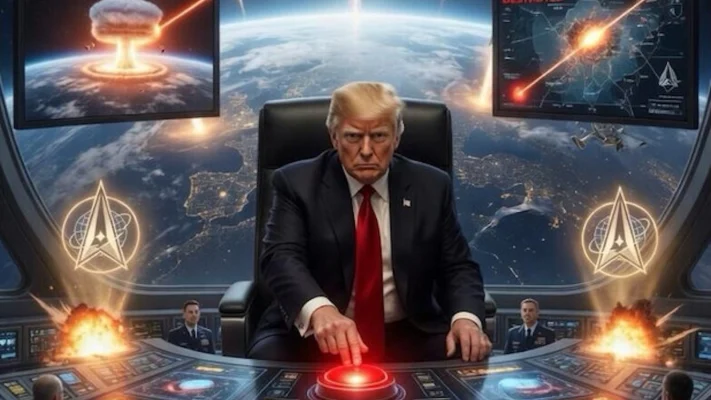
President Trump’s May 2026 post of himself hovering over the “nuclear button” is highly problematic. It also helps explain the difficulty in bringing conflict with Iran to a close as Iran very well understands that in the event of the US withdrawing from the Mid East, the Israel that remains has nuclear weapons. They do not and this realization is existential.
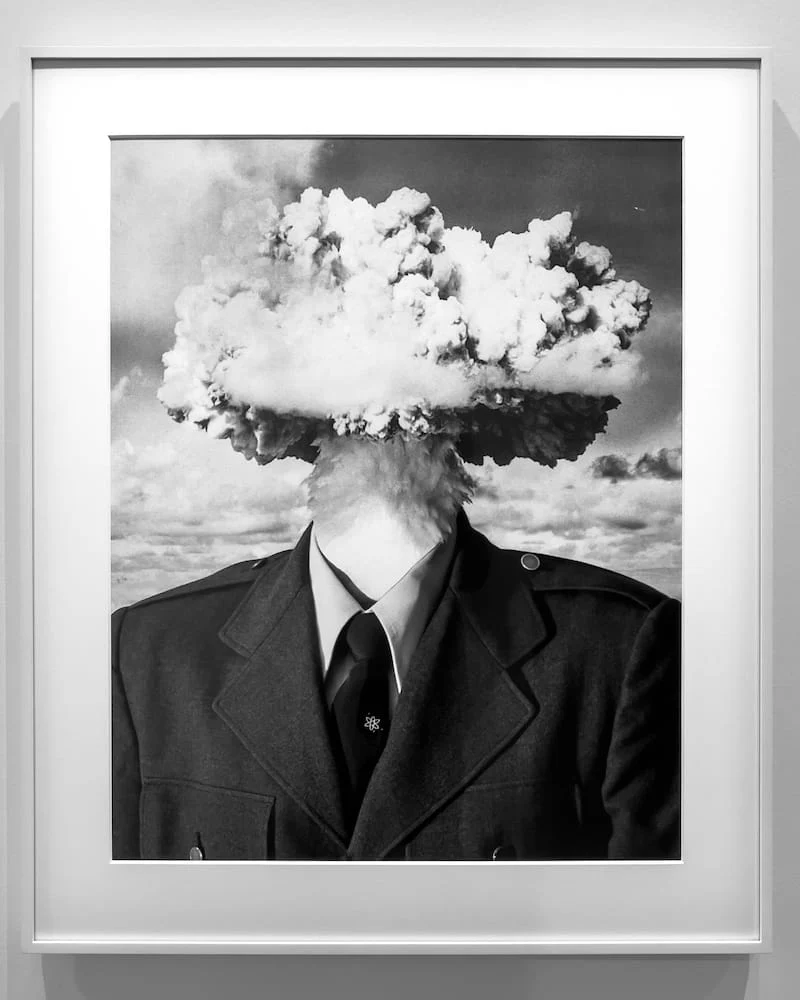
Meanwhile, even after the Cold War, artist Brice Conner in his 2002 “Bomb Head” could still see the threat of nuclear war looming on the horizon.
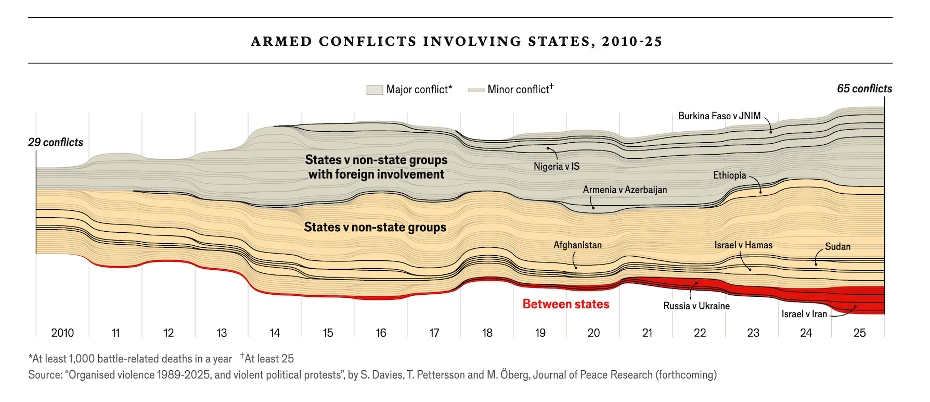
In conclusion, the graphic below in a world where superpowers have become less predictable warrants a closer look. It deserves even closer scrutiny in just seeing Bill Pulte, an individual with no experience in intelligence work, just replacing Tulsi Gabbard as the Head of National Intelligence. Against this backdrop, US and European defense shares that surged strongly last year have retreated YTD and are arguably on sale. This “sale” in the geopolitical environment just described may not last long…
Meanwhile, in my personal allocation that was over 50% cash in early April has been methodically reduced to 20% cash, which will also include short maturity inflation linked bonds. Chinese ADRs (Chinese A shares have had a great YTD) that had been taken off of the table in April are back on. Beyond these exposures, is an idiosyncratic mix of stocks that while focused on valuation are also participating in elevated oil prices, technology, defense as well as an eclectic mix of other stocks that are intended to zig when the epic momentum of the current domestic equity environment abates. A healthy allocation to Berkshire Hathaway under new leadership that is beginning to make some moves under Greg Abel is also included in this allocation.
It is also worth noting that it has been humbling to try to time this market. SOXS, a vehicle that offers levered inverse returns of the semiconductor space which was $48 in late March is today $5.39 as this note is being written. Thankfully, I left this small complementary position back at around $35 on its way down. Today, I am looking to tinker with the best relative value left in the semi space in some combination with SOXS. In terms of why I even try to use SOXS is a continued belief that the war with Iran is going to end as a stunning US setback that gets labeled as something else. This outcome will take time, will strain global supply chains and will matter. In addition, while this still invisible risk exists, other unexpected developments in a post “Pax Americana” world grow from a probabilistic perspective.