
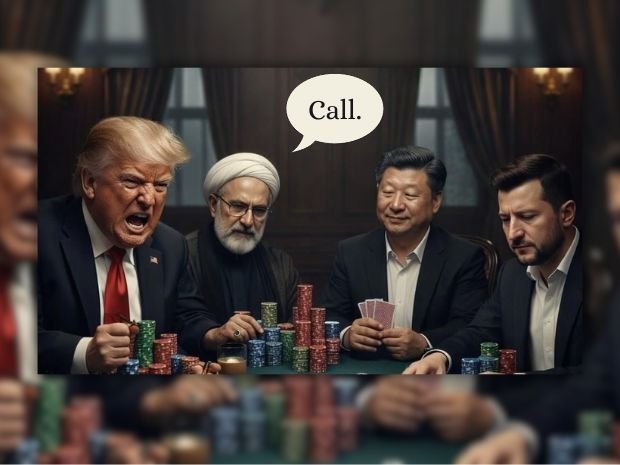
In poker, table talk is an honored art. You project confidence. You suggest your opponent’s hand is weak. In the best cases, this theatrical bravado makes your opposition doubt themselves before the cards are even turned over in a Texas hold’em style of play. But for the most seasoned players, this stratagem only really works if you actually know what cards everyone else is holding. Meanwhile, the Trump administration has seemingly built an entire foreign policy on such “table talk and show”, but geopolitical cards are now being turned over one by one by players who will not be “folding” which include China’s Xi Jinping, Ukraine’s Volodymyr Zelensky and Iran’s Mojtaba Khameini.
The results, so far in this contest from a US perspective, have not been encouraging. Meanwhile, this realization appears to have help spark President Trump to post an image of himself pushing the “nuclear” button on Iran with the quote, “TARGET DESTROYED” over the weekend which represents more of the bravado referenced above. But the time for this showmanship is over. Inflation is trending up globally while the global economy is has begun to the creak under the pressure being released from a still closed Strait of Hormuz. As referenced above, it’s time to see the cards…
“You Don’t Have the Cards”
In February 2025, President Trump summoned Ukrainian President Volodymyr Zelensky to the Oval Office and delivered what was meant to be a master class in power politics. “You don’t have the cards right now,” Trump confidently told him in front of cameras and the world. The message was clear: Ukraine was a supplicant, Russia held the initiative, and Zelensky had better make peace on whatever terms were available before Ukraine disappeared back into a remake of the former Soviet Union.
A little over a year later, Ukraine has taken the battlefield initiative in its war with Russia. It has conducted one of the most audacious long-range drone campaigns in the history of modern warfare, including Operation Spiderweb; a strike deep inside Russian territory that destroyed dozens of Russian warplanes on their own tarmacs. Ukraine’s drone manufacturers are now on track to produce more than 3 million low-cost first-person-view military drones in 2026. The United States, by comparison, built 300,000 in all of 2025. And in perhaps the sharpest reversal of the original power dynamic, the Trump administration, the same one that told Zelensky he had no cards, has been quietly requesting Ukraine’s help in developing drone interceptor technology to counter Iranian drones in the Middle East. “All our institutions received these requests from the US,” Zelensky told reporters. “What American bases need now are interceptors. It’s our technology.”
Trump’s public response was characteristically defiant: “We don’t need their help in drone defense. We know more about drones than anybody. We have the best drones in the world, actually.” The Pentagon declined to comment. The facts, unfortunately, have their own opinion on the matter.
“They’re Playing With a Pair of Twos”
Treasury Secretary Scott Bessent is also fond of poker metaphors. In April 2025, as Washington and Beijing were exchanging tit-for-tat tariff blows with the US escalating from 10% to 20% to 145% on Chinese goods; Bessent appeared on CNBC’s Squawk Box and delivered his verdict on China’s position: “They’re playing with a pair of twos.” The logic was straightforward: China exports roughly five times more to the US than it imports, so American tariffs would hurt Beijing far more than Chinese retaliation could hurt Washington. It was a confident read of the table.
It was also wrong. China punched back hard, raising equivalent tariff barriers and then deploying its most powerful asymmetric weapon: rare earth minerals. Within weeks of China choking off exports of rare earth magnets, US factories producing F-35 stealth fighters, Patriot missiles, Ford F-150 trucks and Explorer SUVs were grinding to a halt. Frantic calls poured in from CEOs and the Defense Department alike. The Trump administration, which had successfully bullied European and Asian allies into tariff concessions not seen since the Smoot-Hawley era, found itself confounded by Beijing. The escalation that was supposed to reveal China’s weak hand instead revealed America’s supply chain vulnerabilities in excruciating detail.
After months of posturing, the White House heralded its eventual trade deal with China as a “massive victory.” Analysts noted that it looked considerably like the previous status quo and that the US had made a significant concession; reversing its decision to expand export controls on Chinese companies, a policy that had previously been described as nonnegotiable. The “pair-of-twos player” had, in the assessment of the global media, not folded. America had blinked first, earning itself the acronym TACO (Trump Always Chickens Out).
The Chip Card That Backfired
Central to the administration’s China strategy was its most prized card; Nvidia. Restricting China’s access to the world’s most advanced AI chips, the semiconductors that power the frontier models driving the next wave of technological competition, was supposed to be a stranglehold. Cut off the compute, and China’s AI ambitions would wither on the vine…
The theory was not unreasonable. But its execution revealed a fundamental misunderstanding of how adversaries respond to existential technological pressure. Faced with the prospect of permanent exclusion from American chip technology, China did not fold. It accelerated. Huawei’s Ascend chip line, developed under US sanctions, improved under US pressure. Huawei, for example, now has a public multi-year roadmap running through 2028. Chinese chip stocks, meanwhile, surged 45% following the Nvidia ban announcement. Cambricon Technologies reported 4,000% revenue growth in early 2025. DeepSeek released an AI model that shook US equity markets, demonstrating that Chinese AI capabilities were far more advanced than Washington had assumed, built in part by squeezing extraordinary performance out of mid-range and restricted chips.
The chip ban did not eliminate China’s AI capability. It gave China an industrial policy justification, a domestic market mandate, and an urgent national security imperative to build its own. In other words, it became China’s “Sputnik” moment for AI. The geopolitical trade “bully” card, played aggressively and without strategic patience, accelerated the very outcome it was designed to prevent. The administration then reversed course, approving H20 (a downgraded export compliant form of Nvidia’s “Hopper” infrastructure…) sales, then banning them again, then approving them again…a pattern of policy whiplash that sent precisely the wrong signal to both Nvidia’s investors and Beijing’s strategic planners.
The Strait That Won’t Open
Which brings us to Iran, where the largest and most consequential miscalculation of the administration’s foreign policy is now fully visible. The war that was supposed to last four to six weeks is in its third month. The Strait of Hormuz, closed by Iran on February 28 in response to the US-Israeli strikes; remains largely sealed, with tanker traffic down 70% and a global fuel crisis metastasizing in real time. US aircraft carriers have been compelled to operate well back from the strait itself, their vulnerability to Iranian drone and missile systems having rewritten the tactical assumptions that underpinned the entire operation.
Iran has not folded. It is playing the hand it has with considerable discipline: keeping the strait closed, absorbing the military pressure, watching a ceasefire that Trump himself described as being “on massive life support” teeter without collapsing. Beijing, as Iran’s largest trading partner and top oil buyer, holds the leverage to push Tehran toward a settlement, and knows it. Xi Jinping received Trump in Beijing last week and agreed to the language of strategic stability. But importantly, Xi also made clear that Taiwan remains China’s primary concern, reminded the room of the Thucydides Trap (an insult to the US that implies that China is a rising superpower while the US, as a superpower, is in decline…), and offered no public commitment to meaningful help on Iran. The cards are visible now. The question is who is holding the stronger hand.
The Crescendo
In a poker game, the table talk eventually gives way to a moment of reckoning. The bets have been placed. The pot has grown. Someone has to call. China has not folded. Ukraine has not folded. Iran has not folded. And the accumulating costs of a still-closed strait; rising energy prices, spiking inflation, depleted missile interceptor stockpiles, strained alliances, and a trade deal that looks like a retreat, are ALL building toward exactly the kind of crescendo that forces action.
But here is the cruelest irony embedded in this tableau: the cards America holds are genuinely strong ones. Reserve currency dominance. The world’s deepest capital markets. Nvidia’s chip ecosystem. The dollar’s role in global energy pricing. Unmatched military reach, when it can be projected. These are real advantages. They are not a pair of twos.
The problem is not the cards. It is the players holding them. A hand that includes rare earth dependencies left unaddressed for decades, alliances alienated precisely when they were needed most, a chip strategy that oscillated between ban and unban with no coherent theory of deterrence, and a military campaign that underestimated its adversary’s asymmetric capabilities; that hand, however strong its underlying cards, has been played with remarkable imprecision.
In the end, the most expensive lesson of the Trump administration’s foreign policy may be this: great cards, played badly, still lose. And at a table where China, Ukraine, and Iran have all refused to fold, the call is coming. The only question is whether the hand revealed will justify the bluster that preceded it.
The chips (a lot of them…), in every sense of the word, are on the table and are about to get redistributed. As this is happening, think about this poker game from China’s perspective. They have seen Trump’s “tells” and they have now also seen the US struggle with Iran and now know that the US will face a steep challenge defending Taiwan militarily right now. Interestingly, in the wake of last week’s US and China summit (eagerly set up by the US and not China…), the writer heard for the first time a US policy fallback plan regarding Taiwan which would be to destroy all Taiwan Semiconductor (TSMC) chip plants before a hostile Chinese takeover. As this dire worry looms, sure to be stellar NVIDIA earnings get released later today against inflationary headwinds that have formed due to war with Iran…
Indeed, a time to “call” has arrived for geopolitical leaders as well as global investors.
Have a great week !