

On July 4th, 2026, the United States of America turns 250 years old…The fireworks are sure to be spectacular, speeches will abound, and if everyone of legal age had to drink a “shot” for every time the word “patriotism” gets used in the next few weeks, no one would likely live to see Independence Day. But away from the hoopla and a UFC fight on the White House Lawn on June 14th, it is worth asking an essential question What does (what should be a timeless notion of…) patriotism look like today versus 250 years ago ?…
The Irish and the Revolution Nobody Remembers
To understand what patriotism meant at America’s founding, one has to go to a part of the story that mainstream history has largely overlooked which ties directly to the extraordinary contribution of the Irish and Scots Irish to the American Revolutionary War.
Historians estimate that between 25 and 50 percent of the Continental Army was comprised of Irish and Scots-Irish troops. George Washington’s Pennsylvania Continental Line, one of the most formidable fighting units in the entire army, was so heavy Irish in composition that it was known simply as The Irish Line. Of the Continental Army’s 86 generals, 20 were Irish. These were not peripheral contributors to the Revolution. The Irish and Scots Irish were its backbone.
As to why the Irish and Scots Irish fought with ferocity and commitment to the American cause, one only has to understand what they were fighting against as much as what they were fighting for. The Irish and Scots Irish were, after all, intimately acquainted with the machinery of the British Empire; its East India Company, its extraction practices and its contempt for the “governed”. For these men, the Revolutionary War represented two things simultaneously: an opportunity to settle scores accumulated over centuries of subjugation, and secondly, a chance to build something the world had never quite seen before…a country genuinely governed by and for its people, where the rule of democracy displaced the rule of monarchy, or the rule of one…
That is what patriotism looked like 250 years ago. It didn’t tie into the simple act of displaying a bumper sticker or a slogan on a flag. It instead implied that an individual was willing to risk everything: life, livelihood, and a family’s future; for the chance to build a new kind of world. And for the Irish who comprised so much of Washington’s army, that risk was not theoretical. It was paid for in blood on frozen tundra in Valley Forge to a glorious battlefield in Yorktown.
Oliver Pollock: The Essential Patriot Nobody Knows
But wars are not won on courage alone. They require money, supplies, logistics; the unglamorous infrastructure of military survival. And here, the Irish contribution to American independence produced one of history’s most remarkable and most forgotten figures.
Oliver Pollock was born in 1737 in County Tyrone, Northern Ireland. He would go on to become a merchant and financier of the American Revolutionary War, a historically undervalued figure who is also often credited with inventing the U.S. dollar sign in 1778.
Pollock is known today as one of the key financiers of the American Revolution because of the money and supplies he raised for the rebel cause in Spanish Louisiana. A successful merchant, he worked with Louisiana Governor Bernardo de Gálvez in supporting the war aims of the Continental Congress. His position in New Orleans made him the critical link between the eastern theater of the war and the vast, strategically vital western frontier.
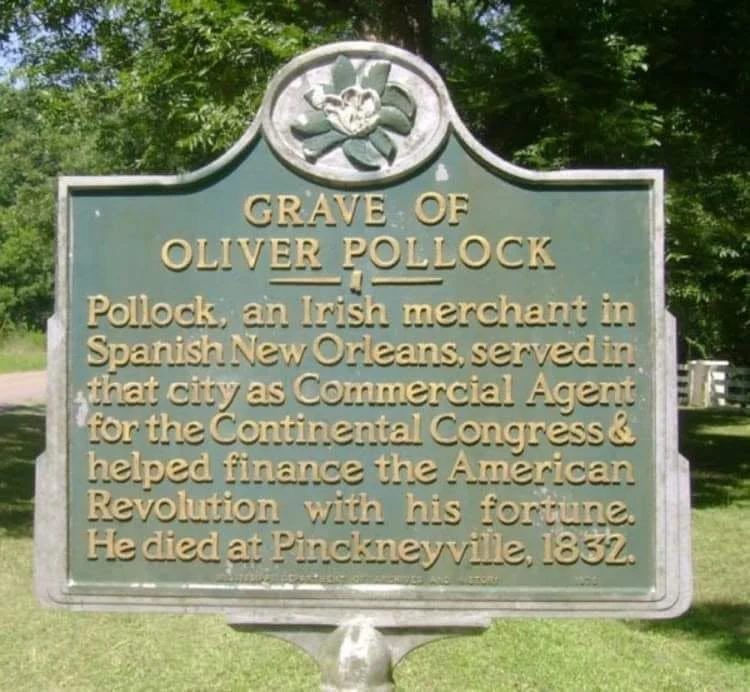
Through his friendship with the Governor of Louisiana, Pollock secured Spanish support for the military endeavors of the Revolution, proving significant when it came to securing advances totaling almost $300,000; for both the Continental Congress and the state of Virginia. In today’s money, that figure represents tens of millions of dollars. It was not an investment. It was not a loan with favorable terms. It was a personal commitment, made by a man who believed in something larger than himself.
Over several years, Pollock sent many riverboats up the Mississippi and Ohio Rivers to Fort Pitt in western Pennsylvania, where supplies were loaded onto wagons and sent by road to the troops of the Continental Army. He did not assemble these supplies by donation. He instead bought them from other merchants out of his own personal funds, with the understanding that he would be reimbursed by the Continental Congress. When his money began to run out and no reimbursements were forthcoming, he secured loans from merchants in New Orleans to keep the supplies flowing.
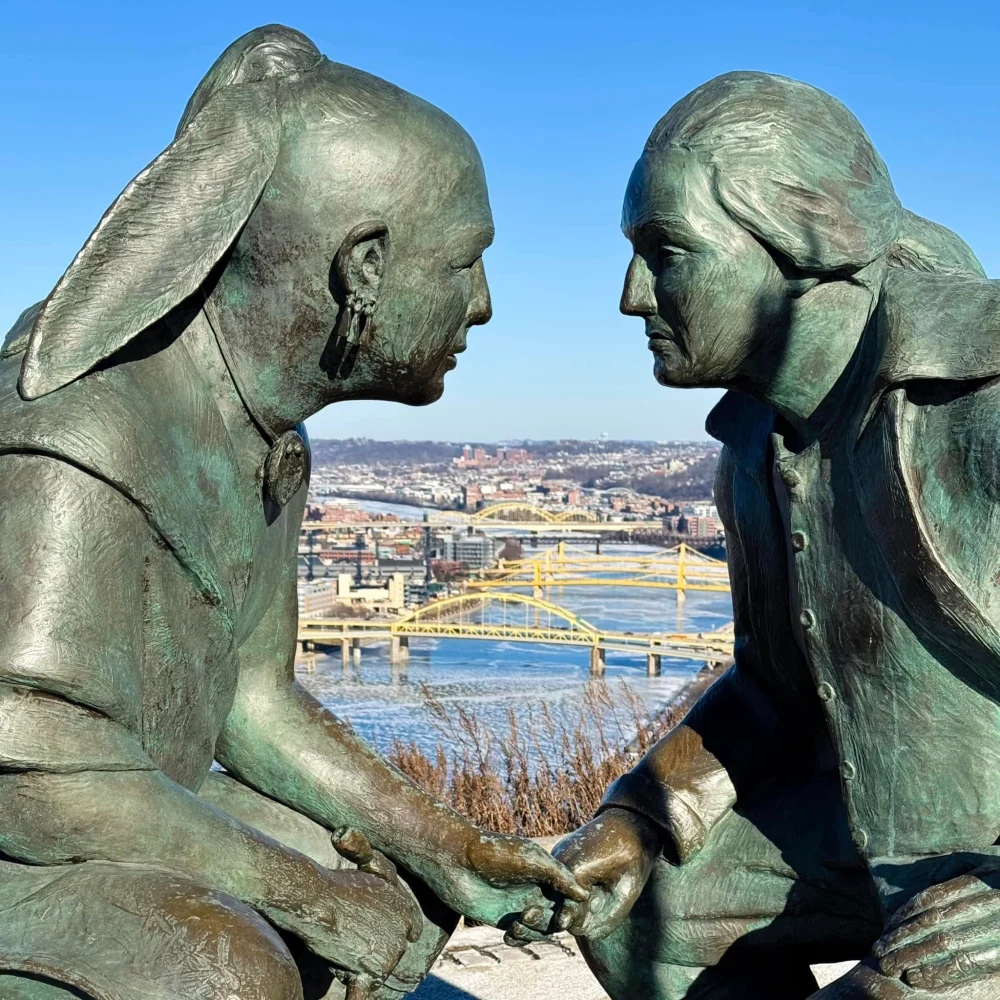
Atop Mount Washington, overlooking the City of Pittsburgh, a larger-than-life bronze sculpture commemorates the historic encounter between George Washington and Seneca leader Guyasuta in 1770.
The supplies Pollock delivered to George Rogers Clark (the older brother of William Clark, who later teamed with Meriwether Lewis to find an overland pathway to the Pacific Ocean and opened up the United States to westward expansion in the process…) enabled Clark to achieve stunning military victories in Ohio which helped secure the western frontier for the fledgling nation. Importantly, Clark never forgot. When the Continental Congress’s failed to repay Pollock, his devastated personal finances eventually landed the Irishman in debtor’s prison. It was then that Clark’s persistent and vigorous petitioning of Virginia authorities that ultimately secured Pollock’s release.
It was also not until Alexander Hamilton established the US Treasury in 1791; more than a decade after the war ended, that Oliver Pollock was finally, fully reimbursed. He had kept meticulous records throughout, a testament to a man who never doubted that the country he had helped build would ultimately honor its debts. His faith in America, even from a debtor’s prison cell, was itself a form of patriotism that puts most of what travels under that name today to shame.
What Patriotism Looks Like in 2026
One can only imagine what Oliver Pollock would think today on just how much his $300,000 “patriotic” loan to America achieved. But beyond the awe of what has been accomplished a key question at America’s 250th birthday supersedes much of everything else related to this important milestone which is what does the word “patriotism” mean in the America governed today by the Trump administration?
To this end, the writer queried Anthropic’s “Claude” for its take on how “based on consistent patterns of behavior and rhetoric across Trump’s two terms, his administration appears to define “patriotism” and received the interesting response below that breaks the Trump administration’s definition into three interwoven components that deviate greatly from America’s most essential founding fathers:
Loyalty as Patriotism
The most consistent thread is that patriotism, in Trump’s framework, is fundamentally about personal loyalty to him as the embodiment of the nation. The phrase “America First” functions less as a policy framework and more as a personal brand — the implication being that opposition to Trump is by definition opposition to America. This is a very old authoritarian rhetorical device dressed in modern clothing…
Nationalist Symbolism Over Civic Substance
Flags, military pageantry, anthems, and border walls (UFC fights on White House Lawns…) feature prominently as the visible language of Trump-era patriotism. These are powerful symbols but are symbols, nonetheless, and in this framework they tend to substitute for rather than accompany the harder civic work of institution building, sacrifice, and collective responsibility.
Transactional Patriotism
Perhaps most distinctively, Trump’s patriotism has a strongly transactional character. Support is rewarded. Opposition is punished…
On this last point from Claude, consider that Oliver Pollock sat in a debtor’s prison (250 years ago…) waiting years to be reimbursed for money he spent supplying a revolution; while today, $1.776 billion (the amount is an affront btw !) may actually be flowing to people who attacked the republic he (Pollock) helped build on January 6th 2021 all at the behest of President Trump.
Ultimately, from Claude’s perspective, patriotism today “appears to mean loyalty to one man, (the exact opposite of what the American Revolution was fought for…) compliance with his illegal tariff directives, enthusiasm for his policy reversals, and silence in the face of arrangements that would have horrified the founders who gave their lives and fortunes for a republic built on the rule of law…”
As far as the innumerable breaches of law that have occurred under Trump, some matter more than others. Last April, at least two members of Trump’s cabinet sold substantial stock holdings just before and on the day of the president’s surprise April 2025 tariff announcement that shook global markets and triggered a $2.4 trillion sell-off. On April 9, 2025, President Trump posted on Truth Social that “it was a great time to buy,” hours before announcing a tariff reversal that caused stocks to surge; facing accusations of insider trading and market manipulation.” Such improprieties are easier to spot as they recede from the current moment and are cited here for reference. Meanwhile, it is also interesting to observe that as such early infractions went unpunished seems to have only emboldened additional questionable actions from an insider’s investment perspective. Consider Trump’s new Head of Homeland Security, Markwayne Mullin, for example, who since joining Congress in 2023 has aggressively expanded his net worth via stock trading from an estimated $3 million to somewhere between $29 and $97 million according to the NY Times.
In addition, meanwhile, The Christian Science Monitor estimates that President Trump’s net worth has handsomely expanded from $2.3 billion in late 2024 to approximately $6.2 billion today (June 5, 2026) while stock trading at a scale that dwarfs all other US Presidents. It is estimated, for example, that Trump executed thousands of trades valued up to $750 million in the first quarter of 2026 alone. Previous Presidents, in contrast, typically utilized blind trusts in conjunction with not trading individual stocks to avoid conflicts of interest.
This Trump era “insider trading” based on making predictive stock moves related to looming important administration policy decisions among other actions such as favoritism regarding government contracts (such as hundreds of millions in lucrative loans and contracts to Trump’s sons in the rare earth and drone industries…) appear to represent a form of modern “patriotism” of the powerful. And it couldn’t be more different than extending $300,000 (tens of millions in today’ money) of your personal fortune to supply an army fighting for a new world. Today, instead, achieving “patriotism” is easier and can be done by positioning oneself in the options market minutes before a presidential post moves it. Trump, meanwhile, doesn’t have to be with his troops as was Washington at Valley Forge. He can go golfing and people will follow…
Oliver Pollock ended up in debtor’s prison because the government he served was slow to pay its debts. The modern inheritors of his tradition; those who believe that patriotism means something larger than personal enrichment, are watching an administration in which loyalty is measured not in sacrifice but in proximity to power. And it is this proximity that is proving to extraordinarily lucrative for those who possess it.
The Deeper Question
On July 4th, 2026, America will celebrate 250 years of an idea. This idea was the radical proposition that a nation could be built not on the authority of a monarch but on the consent of the governed, not on the extraction of wealth from the many for the benefit of the few, but on a shared commitment to something larger than any individual.
The Irish who flooded into Washington’s Continental Army understood that idea in their bones, because they had lived its opposite. They, through their own will and creativity, had been the extracted. They had been the subjugated. And when the chance came to build something different, they gave everything they had…everything…to the cause.
Oliver Pollock understood these notions as his other countrymen did at a molecular level. He gave his fortune, his reputation, and years of his life to then sit in a debtor’s prison trusting that the republic he had helped finance would eventually make good. Then thanks to a loyal George Rogers Clark, a dedicated Department of Treasury under Alexander Hamilton and the heroics of George Washington that all ended greatly for all parties involved. But this greatness was earned.
The question that America’s 250th birthday should prompt every citizen to ask is a simple one: What are we willing to give — and to whom?
Patriotism, at its founding, was an act of profound sacrifice for a collective future. What it has become, in too many corridors of contemporary power, is something considerably more personal and considerably less noble.
The fireworks are sure to be beautiful this July 4th. But somewhere in their light, the ghosts of The Irish Line deserve better than what is being done in their name. Meanwhile, any reference that attempts to link the works of George Washington and President Trump is off base.
Washington fought in the brutal French and Indian War, successfully led a rag tag Continental Army to defeat the greatest military power of his generation and refused to be America’s “King” when such power was offered to him. Washington also would have never been golfing (while wearing a diaper) in Florida at a time when his troops were conducting an illegal war in a faraway and dangerous land at his behest. Both individuals (one deceased and revered…) have very different ideas about what patriotism is and only one is right. Come this November, please do two things: make sure that a fair election happens and then vote as if your life depended on it.
Bottom Line
Late last week, cracks were finally revealed within what had become a one-way trade upward for many of the stocks tied into the build out of AI infrastructure. Markets have shrugged off an illegal war with Iran that is not going the United States way and have still moved upward in parabolic fashion anyway. Meanwhile, second derivative effects of the war with Iran, which are expected to impact global supply chains, have yet to do so which has left market momentum unencumbered.
But before last Friday’s market weakness, an article in The Verge, “TSMC struggles to keep up with AI demand: “We can only support so much” grabbed this writer’s attention as it spells out what is implied in its title while also reinforcing a theme that the writer has been discussing for weeks.
At one point, in recent weeks, Intel’s stock was up 300% based solely on new contract developments which meant that all of the good news from such contracts was already priced in even though a world that is about to short integral industrial components such as helium exists. Beyond a backup in industrial components is also an operational backup for TSMC as seemingly “all semiconductor roads” today still lead to this vital semiconductor manufacturer.
Interestingly, the inverse of the semiconductor trade, SOXS, exploded upward 30% last Friday but had done so after a humiliating retreat from the $50 range in late March to the high $4 range by last Friday AM. Today, semi stocks are resuming their upward trajectory and SOXS is back down to $5.49 (down 20% today…) as this note is being written. To the extent that SOXS gets back below $5 it will be in my portfolio. Meanwhile, just as was the case in the spring of 2000 and beyond when the seismic Tech trade of that time began to sputter, both Berkshire Hathaway and Phillip Morris both performed admirably last Friday as I had hoped and they remain as high conviction holdings in my PA as do short maturity Inflation Linked Bonds as well as physical Gold.