
A Young Frenchman in Search of Hope
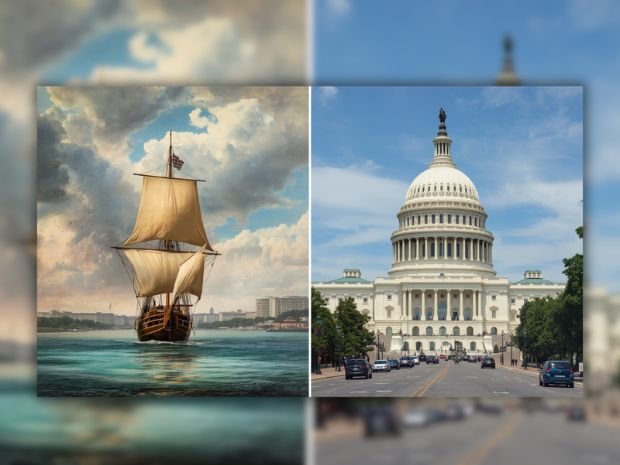
In 1831, a twenty-five year old French magistrate named Alexis de Tocqueville boarded a ship bound for America. He went, officially, to study the American prison system. But what he was really looking for was something far more personal and far more urgent as he was seeking answers and hope.
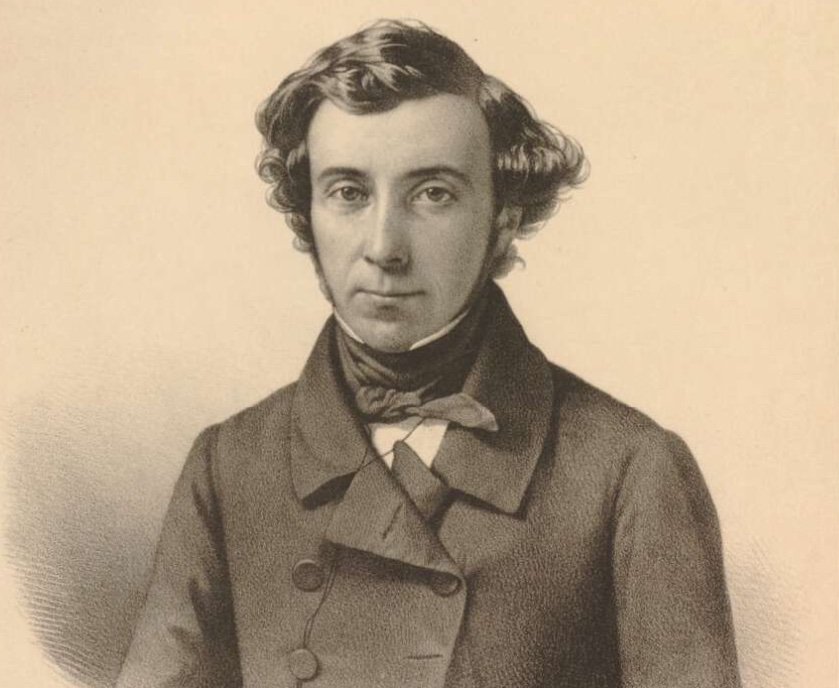
Léon Noël, Alexis de Tocqueville (1848). Wikimedia Commons / Public Domain
De Tocqueville, after all, came of age during a period of chaos from a French governing perspective. While predating de Tocqueville, France’s Reign of Terror of 1793 and 1794 that toppled the French monarchy, for example, that sent thousands to the guillotine in the name of liberty; then gave way to the dictatorship of Napoleon and a generation of unrelenting war across Europe and beyond.
Napoleon’s final defeat at Waterloo in 1815 did not resolve France’s governing crisis but merely reshuffled it. The Bourbon Restoration that followed; first under Louis XVIII and then the more reactionary Charles X, attempted the uncomfortable balancing act of grafting constitutional rights onto monarchical rule, with those rights tilted firmly toward the country’s wealthy bourgeoisie. When Charles X moved to then further restrict civil liberties away from its fragile state of affairs, the French people rose up in its “Three Days of July 1830”, sacking him and installing the “July Monarchy” under Louis-Philippe, a liberal constitutional arrangement that replaced one form of elite rule with another, somewhat more palatable version.
This was the France de Tocqueville knew: a nation lurching between revolution and reaction, unable to find stable ground, its political experiments leaving rivers of blood behind in its wake and palpable uncertainty in the air. Based on his writing, de Tocqueville was a brilliant young man from a noble family who had to be acutely aware that the governing aristocratic world he had been born into was dying and had to be genuinely unsure what should or would replace it.
America, by 1831, in contrast to France, had been a functioning republic for more than four decades. It was imperfect as de Tocqueville would see its racial contradictions clearly and record them honestly. But it was working, in ways that France desperately needed to understand. De Tocqueville came looking for a governing model but found something more fulfilling; a meditation.
De Tocqueville believed that equality was the great political and social idea of his era, and he thought that the United States offered the most advanced example of equality in action. What he observed and eventually recorded in “Democracy in America”, published in 1835 and still read in universities around the world nearly two centuries later, was not a simple celebration of American institutions. It was a nuanced, prophetic, and in places deeply worried analysis of what democracy makes possible, what it threatens, and what it requires to survive.
As a result, de Tocqueville was perhaps the most perceptive foreign witness America has ever had. Which makes the question irresistible: if Alexis de Tocqueville returned today, almost two hundred years after he first set foot on American soil, what would he write about America from a first-hand view for his French countrymen today ?
What de Tocqueville Admired — And Why It Matters Now
De Tocqueville arrived in America prepared to be skeptical. What he found instead was something that genuinely moved him. The central fact that captured his attention was the equality of conditions and its pervasive effects upon the spirit of the country. He observed a society where a man’s birth did not determine his station and where the farmer and the merchant and the lawyer met on roughly equal civic footing. Coming from a France still sorting out which aristocracy to privilege, this was nothing short of revolutionary.
He also found, to his genuine surprise, that America’s religiosity was a strength rather than a liability. He observed that the strong role religion played in the United States was due to its separation from government; a separation all parties found agreeable. De Tocqueville contrasted this balance between secular and spiritual forces favorably relative to France, where there was an unhealthy antagonism between democrats and the religious.
American religion, in his view, served as a moral counterweight to democracy’s natural tendency toward materialism and selfishness. It bound communities together. It provided an ethical architecture that pure political theory could not supply. In other words, this nuanced balance between secular and spiritual considerations in America tempered individualism without crushing it.
Our American History
At a societal level, de Tocqueville admired the voluntary associations Americans formed; civic clubs, religious congregations, local political organizations, as the connective tissue of democratic life. He considered local governments and judiciaries crucial, and respected Americans’ religious vigor even while noting that religion in America tended to fit into the mold of democratic ideals.
And de Tocqueville marveled, above all, at the simple durability of the thing…this Democratic thing. Here was a republic that had survived, was growing, was producing prosperity and civic energy on a scale that Europe had not imagined possible. For a young Frenchman who had watched his country tear itself apart over and over again, it may have felt like utopia.
What de Tocqueville Feared — And What He Predicted
But de Tocqueville was not a myopic cheerleader. He was a diagnostician. And alongside his admiration he recorded a series of warnings that read, two centuries later, less like historical observations and more like a newspaper from this morning.
His most noteworthy concern was what de Tocqueville called the tyranny of the majority. This was the danger that in a democracy, the sheer weight of popular opinion could crush minority voices and individual rights as effectively as any monarch.
De Tocqueville also warned of what he called soft despotism, which represented a more insidious threat than outright tyranny. Democracy, he argued, tended to degenerate into soft despotism, and he warned that democracy fostered intellectual and moral habits that could be deadly to freedom: the tyranny of the majority, individualism, materialism, and democratic despotism.
Excessive wealth, left unchecked, was another potential trouble spot for the sustainability of a Democratic form of government from de Tocqueville’s perspective. To this end, he warned that “friends of democracy must keep an anxious eye peeled in this direction at all times,” observing that the route of industry was the gate by which a newfound wealthy class might potentially dominate.
And here de Tocqueville stumbled onto something fascinating as he believed an industrial aristocracy would differ from a formal aristocracy of the past. Such a rising class in his view would not replicate the structure of the old aristocracy and why would they ? Instead, de Tocqueville feared the domination of a new rising industrial class might produce something worse; a class of people with all the power of aristocrats but without any of their historically entrenched paternalistic obligations.
So what would a modern-day Alexis de Tocqueville find in America in 2026 at its 250th Birthday ?
Let’s take a leap and together imagine de Tocqueville stepping off of his ship not in 1831 but today. He would recognize much. The vastness of the country, its energy, its restlessness. The religiosity. The appetite for association and argument. The fundamental decency of ordinary American life…but then he would begin to notice something else very wrong…
The Rule of One
While De Tocqueville feared the tyranny of the majority, today he would instead find something far worse, the governing architecture of a “rule of one”. Here, a presidency has bent the institutions of the republic; the Justice Department, the civil service, the military chain of command, the regulatory apparatus and all for the purpose of establishing personal loyalty which then allows for personal enrichment while serving the public. After all, de Tocqueville would be quick to observe that a political party that has ceased to be a coalition of ideas instead has become an extension of a single man’s will.
It is on this last point that the attached “They Confirmed Her” published on Substack by Mike Brock is included in this article. This inclusion isn’t intended to pick apart the unqualified and now resigned Director of National Intelligence, Tulsi Gabbard. Instead, the point powerfully made in this article is that despite being a lifelong cult member and someone who would likely turn over classified information to the head of the Science of Identity Foundation (the cult to which Gabbard was a part of since childhood…) and someone who filled her staff with co-religionists, Tulsi Gabbard was confirmed on a party line vote anyway. The trail of breadcrumbs around this story and a compromised Gabbard is more like a trail of bagels and to this point, Mr. Brock poignantly offers:
Mike Brock: “They Confirmed Her”
“…Eight Republicans on the Intelligence Committee voted yes (to Gabbard’s nomination…). The forty-five Republicans on the Senate Floor voted yes. The constitutional immune system that exists for the express purpose of catching this (a compromised individual who could gain access to America’s most valued secrets at an intelligence level…)…did not catch it. The system saw it. The system was told about it. The system confirmed her…This is what institutional capture looks like…”.
And take a big whiff because the nominations of Kristi Noem Kash Patel, Pete Hegseth, Bill Pulte and more all fit this pattern. De Tocqueville would see this pattern and likely find himself thinking about his country’s 17thcentury “Sun King”, Louis XIV, who boldly declared “L’État, c’est moi” (I am the state…) as he asserted absolute power (at the expense of the nobles and people…) through divine right and connected the French monarchy and nation as the same…
For the nominations of an almost entire cabinet of unqualified individuals into key administration appointments is precisely the “soft despotism” (it’s more than soft…) de Tocqueville predicted. Not an overt and explosive authoritarian seizure of power, but instead a slow, administrative, almost bureaucratic consolidation of authority that happens in full public view, wrapped in the language of democracy while hollowing out its substance. The forms remain. The elections continue. But the independence of institutions that gave those forms meaning has been systematically eroded.
The Corruption of Religion
Perhaps nothing would disturb de Tocqueville more deeply than what has become of American religion in political life. He saw American faith as democracy’s great moderating force; the check on materialism, the source of moral authority that stood apart from and above the political. Its value, in his analysis, derived precisely from its independence.
What he would find today is something he would struggle to categorize; a religious right that has not tempered materialism but embraced it wholesale. De Tocqueville would also note that the religious right does not stand apart from political power but has fused with it to the point of deifying the country’s most powerful man himself.
To this end, De Tocqueville believed that when religion entangles itself with political power, both are corrupted. Here religion loses its moral authority and sees that it is okay to criticize the Pope as being “soft on crime…” , while democracy loses its ethical foundation. Ultimately de Tocqueville would see that corruption had engulfed the nation’s institutions which again, leads back to the nefarious rule of one.
The New Aristocracy: Billionaires and Lobbyists
De Tocqueville worried about the rise of an industrial aristocracy; ultra wealthy men who might purchase the levers of democratic government for private ends. Two centuries later, he would find his fears not merely confirmed but exceeded.
Consider AIPAC; the American Israel Public Affairs Committee. In the 2024 election cycle, AIPAC spent a record amount to defeat two progressive legislators critical of Israel, Jamaal Bowman and Cori Bush, with more than $29 million in AIPAC dollars flowing into those two races alone, making them among the most expensive House Democratic primary elections in history.
AIPAC spent money on more than 80 percent of the 469 seats up for reelection in 2024; 389 races in total to seek influence over 363 House seats and 26 Senate seats. This is not lobbying in the traditional sense. Let’s also not forget the $9 million AIPAC just spent to help defeat Kentucky Republican, Thomas Massie, who was against war in Iran and also wanted the release of the Epstein files. Ultimately, all of this activity equates to the systematic purchase of congressional composition: the buying of a legislature, race by race, to ensure that a foreign policy priority is insulated from democratic accountability.
De Tocqueville would note the irony presented above with characteristic precision as the European nations that lack such mechanisms of concentrated financial influence in their own politics have been free to say what many Americans privately think. These private thoughts being that the war with Iran was initiated at the behest of Israel, that American money and credibility are being spent in service of interests that are not straightforwardly American.
Let’s also not forget Peter Thiel, a figure de Tocqueville would find almost fascinating. Thiel built his fortune co-founding PayPal and Palantir Technologies, and has spent decades using his wealth to reshape Republican politics in his image; bankrolling candidates and causes that advance his idiosyncratic blend of libertarianism, nationalism, and authoritarian impulse.
Thiel’s most significant political investment has been JD Vance — whom he mentored, employed, introduced to Trump, and then bankrolled with a record $15 million in his 2022 Ohio Senate campaign. Vance is now Vice President of the United States. Since Trump’s inauguration, Palantir has been awarded over $1.3 billion in federal contracts to provide services across virtually every major department of the executive branch.
As a result, Thiel is a man who has purchased a Vice President, placed allies throughout the executive branch, secured more than a billion dollars in government contracts for his company, and done all of it without running for office and without any democratic accountability whatsoever. Thiel himself has written that he no longer believes freedom and democracy are compatible. He is not hiding this. He is acting on it in plain sight, with extraordinary effectiveness. Meanwhile, de Tocqueville would note that his European countrymen, again not burdened by the weight of American lobbyist influence, in France and Germany have moved entirely away from Palantir as the Dutch appear to be quickly moving in the same direction.
De Tocqueville warned about an industrial aristocracy that would differ from the formal aristocracy of the past. Thiel is precisely what he imagined: a man with all the power of an aristocrat, none of the obligations, and a philosophical framework that explicitly rejects the democratic premise.
The Inversion of His Greatest Fear
And here is perhaps the most profound irony of all — the one that would arguably most arrest de Tocqueville’s analytical attention.
While de Tocqueville feared the tyranny of the majority, what has actually materialized in 2026 is almost precisely its opposite: a tyranny of an organized, technologically empowered minority.
Democracy fosters intellectual and moral habits that can be deadly to freedom; the tyranny of the majority, individualism, materialism, and democratic despotism. De Tocqueville understood that democratic majorities could crush dissent through the sheer weight of opinion. What he did not anticipate was that technology and social media platforms could allow a minority; sufficiently organized and funded, willing to use every available tool to manufacture the appearance of majority sentiment at any cost. This whole enterprise that is operating without government regulation is intended to “game” the algorithms that shape what people see and believe for the purpose of suppressing and distorting public discourse with a precision that no actual majority could achieve.
Our American History
The religious right is a minority of the American population. The billionaire class is also only a small fraction of it. AIPAC’s positions on Middle East policy do not represent majority American opinion. And yet each of these minority forces has achieved a grip on American political outcomes that the democratic majority cannot seem to shake loose from. The tools of the information age; social media, algorithmic curation, targeted political advertising, and data surveillance…have collectively given organized minorities capabilities that de Tocqueville’s majority-fearing imagination never conceived.
He worried about the mob. What arrived instead was the algorithm.
What Would de Tocqueville Conclude?
Alexis de Tocqueville came to America in 1831 looking for hope, and he found it. He found an imperfect and contradictory nation but still a country with vast potential, a functioning Republic and one where a rigid stratification of society had yet to fully form. All in all, 1830’s America was magnificent and de Tocqueville, inspired by his journey, returned to France and wrote a book that has outlasted most of the governments that have come and gone in the nearly two centuries since.
If de Tocqueville would return to America today with a similar mission, he would be less resolute.
He would still find the essential American energy — the restlessness, the optimism, the capacity for reinvention that has always been this country’s deepest gift. He would find millions of ordinary Americans living lives of decency and civic purpose that would have gladdened his nineteenth century heart.
But he would also find his darkest predictions confirmed and, in some cases, exceeded. The soft despotism he feared. The corruption of religion he warned against. The new aristocracy of wealth he anticipated. And a new threat he could not have imagined — the tyranny not of the majority but of the organized, technologically armed minority.
He would not despair — de Tocqueville was constitutionally incapable of despair. But he would issue a warning, in the elegant and precise French of a nineteenth century liberal who had seen what happens when republics lose their way:
The health of a democracy is not measured by the grandeur of its ambitions, but by the integrity of its institutions, the independence of its religion, and the equality of its citizens before the law. When these erode — slowly, administratively, wrapped in the language of the very democracy they are undoing — the republic does not fall with a crash. It dissolves, quietly, while everyone is watching something else.
He would also note that a President who signs a flimsy peace treaty in the French palace at Versailles has also probably never read a history book in his entire life and is more concerned with aesthetic opulence rather than durable substance.
The Atlantic: America’s First Post-Text President
America, on the eve of its 250th birthday, would do well to listen.