
America is so deeply politically divided at its 250th birthday that it needs two separate and distinct celebrations on its opposite coasts on July 4th to celebrate this seminal holiday.
(https://time.com/article/2026/06/29/America-250th-birthday-Fourth-of-July-Donald-Trump-Freedom-250/ ).
But political schism does not disqualify what remains as a noteworthy achievement in longevity for this still young political experiment. And one way to elevate, above the current related noise, a political conversation during what is a challenging time for the American Republic is to focus on its mythology. To be clear, there’s no “hocus pocus” intended in this statement and please read on as this notion of aggregating a nation’s collection of intangible, sacred and traditional stories into an interwoven belief system has the ultimate alchemic power of transforming a collection of individuals into a unified people.
Such a belief-oriented framework represents power, and nothing is more essential to the foundational pillar of American mythology as its notion of “frontier”. Here, even though the American frontier was officially closed by its census bureau in1890 and thus appears as an outdated concept; the Trump administration remains active in perpetuating its own subliminal ideas on what its notion of “frontier” means today.
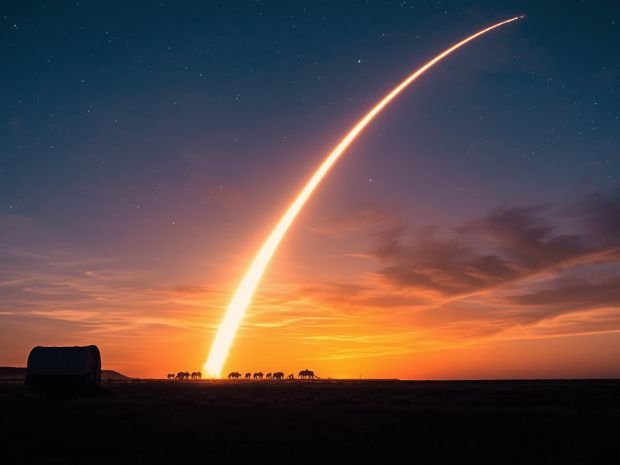
This modern notion of frontier looks to not only include foreign countries and areas such as Venezuela, Iran, Cuba, and Greenland but then also outer space as a final frontier (and yes…this sounds like the opening to the original Star Trek series from the 1960’s…) for where America can foster hope for growth for its current and future generations. But such boundless ambition appears to have limits as the Trump administration aims to pursue this new set of frontiers to capture the American imagination while also cutting the most essential services that it provides to many of its same citizens.
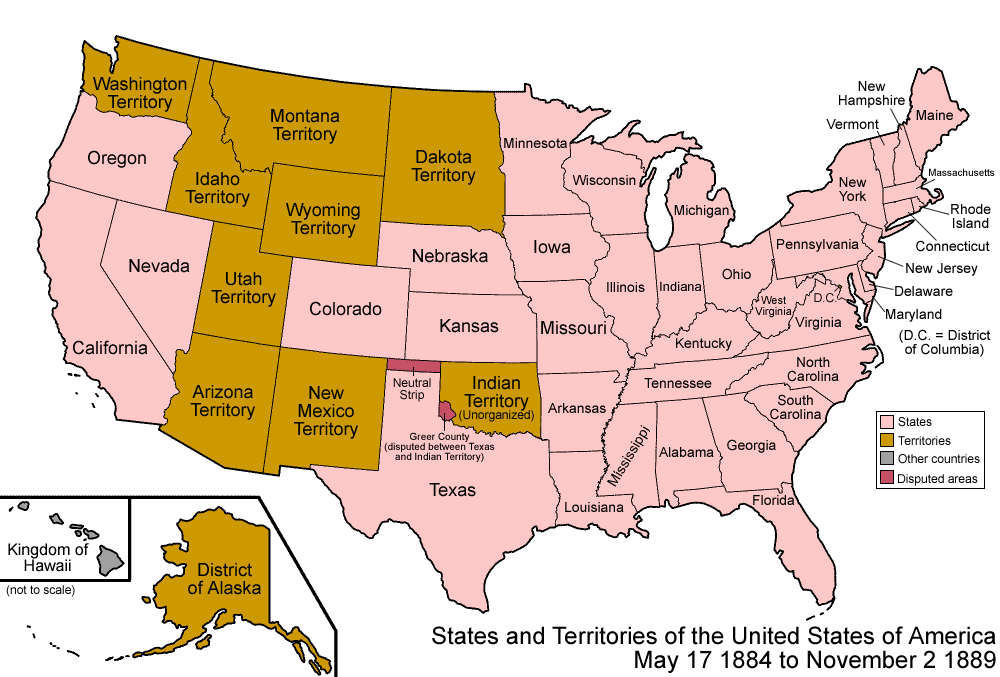
Source: https://en.wikipedia.org/wiki/American_frontier#/media/File:United_States_1884-1889-11-02.png
In 1890, the United States Census Bureau made a quiet bureaucratic announcement that would echo through American history for more than a century. The bulletin declared:
“Up to and including 1880 the country had a frontier of settlement, but at present the unsettled area has been so broken into by isolated bodies of settlement that there can hardly be said to be a frontier line.”
Thus, as determined by the dry language of census bureaucracy, a great chapter of American life had ended…quietly until…
Three years later, a young professor from Wisconsin named Frederick Jackson Turner stood before the American Historical Association at the Chicago World’s Fair and delivered what arguably remains as one of the most influential essays in American history. It was then that Turner argued that the continuous westward expansion and availability of “free land” (someone forgot to distribute this memo to Native American peoples…) were the primary forces that shaped American democracy, individualism and national character. Turner’s three key concepts around his American frontier thesis rested upon:
- A definition of the American Frontier as representing the intersection between where “savagery and civilization” meet.
- A safety valve notion where Jackson argued that America’s frontier allowed the nation’s easterners an escape from being unemployed and or living in the squalor of overcrowded cities an opportunity to start all over by heading west.
- A creation of a new American identity that eclipsed the rigid traditions of Europeans as its pioneers were forced to adapt to the wilderness (on the frontier) that in turn fostered a unique culture of self-reliance, ingenuity and “rough-hewn democracy.
Source: Google Gemini
In other words, behind the life force driving America’s institutions, its constitutional forms, its democratic character was the vital force of the American frontier itself.
Turner’s argument was sweeping; it was also selective as his frontier was a “white man’s” frontier that conveniently photo shopped Native Americans out its canvas of what American history or inevitable progress looked like. The brutal truth of westward expansion, after all, included the forced displacement and ethnic cleansing of about 60,000 Native Americans during the years of 1830 to 1850 by the US government which marked one of the darkest periods in American history and was also known as the “Trail of Tears”.
Frederick Jackson Turner

Source: https://en.wikipedia.org/wiki/Frederick_Jackson_Turner#/media/File:Frederick_J.Turner(Wisconsin_Authors,_1918).png
But while ruthlessly Machiavellian in its premise, Turner’s core insight was ultimately penetrating and has proven durable.
When its frontier closed: America looked outward and inward
Unbeknownst to most Americans of the time, the consequences of the closing of the American frontier in 1890 were immediate, profound, and served to reshape the fledgling country in ways that continue to reverberate today.
With no more western land to absorb the nation’s restless energy, for example, the United States began looking beyond its natural geographic borders for new frontiers. Within a decade of the census bureau’s announcement, America had annexed Hawaii, fought the Spanish-American War, and acquired Puerto Rico and the Philippines. Thus, America’s frontier impulse had not died; it had simply found new geography. Turner himself speculated that as the North American frontier was ending, a new frontier would have to be pursued, because the country could not maintain its self-concept of being a nation based on ideals without some kind of challenge to contend with.
The closing of the frontier also produced a counter Machiavellian movement toward conservation that recognized, for the first time, that America’s wilderness was finite and therefore precious. This awareness began with Yellowstone being deemed a national park in 1872. Yosemite followed next by becoming a national park in 1890 and the conservative minded “Sierra Club” was founded in 1892 just two years after the American frontier closed. As a result, the same psychological forces that had driven Americans to “consume” the wilderness then also partially turned to preserving it. Interestingly, this tension between exploitation and conservation of American resources continues to this day.
Beyond serving as a catalyst for kick starting expansionistic foreign policy while also spurring some movement toward conservation, the closing of America’s frontier also helped drive massive urbanization which moved at warp speed. Here, the cities that grew from an influx of displaced frontier energy also became the incubators of a new American dynamism now known as the Gilded Age. It is within the Gilded Age that tensions exploded between concentrated capital and working people. The counter to this capital versus labor class conflict then gave rise to a progressive movement that sought to balance fairness for workers and better living conditions while preserving an environment where American business could still thrive. Indeed, Turner’s safety valve analogy for describing the importance of the American frontier proved prescient as once it was closed, the pressure from the masses had to find somewhere else to go and they found that place in American cities.
Ultimately, the lesson of 1890 is one that America has arguably had to relearn in every generation since: a nation built on the mythology of infinite possibility does not respond gracefully to the closing of its horizons. It searches, sometimes wisely and sometimes recklessly, for new outlets.
Trump’s Frontier: Walls, Space, and the Mythology of Dominance
Fast forward to the present, and the frontier mythology Turner identified is alive; but has been radically reinterpreted.
The Trump administration, for example, has placed its own unmistakable fingerprint on the concept of frontier, bending its traditional meaning away from the metaphor of boundless outward expansion and toward something that combines national protection, militarism, and commercial dominance. There is a certain genius in this reinterpretation in that it speaks to the same deep American psychological need that Turner identified; the need for a horizon, a challenge, a frontier to define oneself against, while inverting some of the traditional direction of what frontier means.
Trump’s border wall is the most visible expression of this “inversion”. Where the original frontier was a line Americans moved beyond, the wall is a line designed to keep others out. It is frontier mythology turned defensive and not a gate of escape into unlimited possibility. Instead, it is a barrier against perceived foreign threats. The symbolism is unmistakable: this is where American territory and civilization ends, and the wall marks that ending with concrete and steel.
But away from the fatalism that can be associated with a border wall, the Trump administration has simultaneously looked upward and into the digital world for a new expansionistic frontier. The creation of the US Space Force as the sixth branch of the armed forces was not merely a military reorganization, for example, it was a statement of mythological intent. Space, in this framework, is the new West: vast, largely ungoverned, and available to those with the will and technology to claim it. The frontier impulse that once drove covered wagons across the Great Plains has been repackaged and pointed at the stars, with fighter pilots and satellites replacing cavalry and forts.
And let’s certainly not forget AI; the arguable third frontier of the Trump administration that has been pursued with the same deregulatory fervor that once characterized the opening of western lands. Strip away regulation, this administration’s implicit logic runs that American innovators will do what American pioneers have always done: go further, faster, and more boldly than anyone thought possible.
As a result, quietly, the Trump administration is pursuing a coherent “frontier” mythology that is being powerfully deployed…But unlike the early 20th century in America and its outcome, whether or not the new frontiers of the Trump administration also serve the collective good remains open to enormous scrutiny as its pursuit of space and AI right now appear to largely serve political interest and the needs of its architects only.
For those fortunate enough to have access to a 401K and the stock market, these individuals can not only invest in America’s new frontiers but can also protect themselves from its outcome. For everyone else expecting a return of a modern 21st Progressive Movement led by the country’s largest tech leaders, based on recent comments made by these modern “robber barons” as well as the wealth being accumulated by contemporary US politicians, the writer implores them to not necessarily hold their breath.
SpaceX and the Trillion Dollar Leap of Faith
This conversation around the evolution of the American frontier now leads almost naturally to the SpaceX IPO of June 2026.
SpaceX completed the biggest IPO in history, raising $75 billion and debuting on the Nasdaq under the ticker SPCX at $135 per share which established an initial eye-popping market capitalization of approximately $1.77 trillion (out of the gate…WOW!) which has since grown to in excess of $2 trillion.
To put this development in perspective, the Space X valuation stands in sharp contrast to traditional aerospace and defense companies, which generally trade at much lower market values due slower growth expectations. To this end, investors are not valuing SpaceX solely as a launch provider. Instead, they are assigning a premium based on its leadership in reusable rockets, satellite communications, and the potential expansion of the commercial space economy, comparing SpaceX less to aerospace firms and more to high-growth technology companies. In other words, Space X represents a new frontier.
Meanwhile, Space X’s numbers are staggering and its ambition is genuine. Its essential Starlink subcomponent accounted for approximately 61% of total company revenue in 2025, generating $11.4 billion, which represented a 50% increase from the prior year. Beyond growth is also diversification with more than 10.3 million active customers that span 160 countries. Beyond a real business and technology (and let’s also not forget that exclusive Starlink access for Ukraine at the expense of Russia essentially turned the tide in this conflict toward Ukraine’s favor…) is also a ten-year lead over competitors in the “launch” sector as well.
But a portion of the jury remains importantly out on Space X. Morningstar believes that Space X, at IPO, is largely overvalued. One analyst has also recently noted that to justify its current valuation, investors need to look out over “a kind of 20 to 25-year time frame” which makes SpaceX “a much longer-dated equity story than most.” (Source: Claude)
In addition, Space X’s IPO prospectus relied heavily on a total addressable market of $28.5 trillion — described as the largest in “human history” — of which roughly 90% was attributed to artificial intelligence through SpaceX’s recently acquired xAI subsidiary. An existing SpaceX shareholder described the valuation as alarming given the company had been valued at $400 billion just thirteen months earlier, attributing the premium to confidence in Musk personally rather than conventional financial metrics. (Source: Claude)
Ultimately with regard to Space X, what is being sold here, in addition to shares, is a story. And the story is unmistakably “Turnerian” “the frontier is open again” and the horizon has been extended. Bet on America’s capacity to go further and faster than anyone thought possible, and the rewards will be commensurate with the audacity of the vision.
The Question the Trump Administration Mythology Cannot Answer
And here is where the celebration of frontier mythology must give way to a harder question — the one that the fireworks of the 250th birthday and the euphoria of the SpaceX IPO cannot quite drown out.
Mythology and collective stories of origin, as has been discussed, provide the foundational narrative of a nation’s ethos that alchemically transforms a collection of individuals into a unified people with shared values, identity, and destiny. Turner’s frontier mythology served this purpose well for more than a century. It gave Americans a story about themselves that was energizing, unifying, and largely believed.
But America’s collective ethos in 2026 is not unified. It is profoundly splintered — along lines of class, geography, ideology, and access — in ways that a $2 trillion Space X market capitalization cannot paper over. The frontier mythology of AI and space exploration is genuinely exciting to the portion of America that holds financial assets and participates in capital markets. It is considerably less electrifying to the portion of America that relies on Medicaid for healthcare, whose Social Security benefits face uncertain futures, and whose relationship to the frontier of orbital data centers is limited to paying for the satellite internet connection that reaches their rural community.
The SpaceX IPO is a bet on America’s capacity for frontier innovation. But Turner understood that the frontier only functioned as a national safety valve when it was, at least in aspiration, available to everyone. The promise of the West was that anyone — poor, immigrant, displaced — could go there and remake themselves. The promise of the AI and space frontier is available, in practice, to a much narrower slice of the population.
As of right now, investors remain keen on AI infrastructure but considerably less enthusiastic about the stars. The SpaceX IPO, for all its historic scale, has yet to take flight with shares down over 2% since IPO as the writer finishes this note after 3PM on Wednesday. Markets may be forward-looking but are also not infinitely patient, and a frontier whose payoff is measured in decades that is overly reliant on a mercurial and controversial CEO is an arguable reach regardless of how good the story is. Nevertheless, passive investors are going to be Space X investors anyway…
Turner’s frontier worked as a national mythology because it resolved, or at least deferred, the tensions of American society. The new frontier — AI, space, the orbital data center — is being built on top of these unresolved national tensions despite them. Meanwhile, an enormous contradiction soon becomes the elephant in the American political room when a nation cannot simultaneously celebrate the limitless promise of Mars and beyond while it fails to fund Medicaid that helps keeps its earthbound citizens alive…today. There’s no mythology adept and powerful enough to overcome this gaping contradiction which is now faced by the Trump administration. Mid term elections, meanwhile, loom in November…
America at 250: The Frontier Endures
On its 250th birthday, America remains what it has always been — a nation defined by the audacity of its aspirations, the vitality of its imagination, and the persistent, maddening gap between its ideals and its practice.
The frontier mythology that Turner identified in 1893 is alive. SpaceX is real. Artificial intelligence is transforming the world with a speed and scale that would have astonished every previous generation of Americans. The restlessness, the innovation, the refusal to accept that any horizon is truly final — these remain among the most powerful forces on earth, and they are still, unmistakably, American.
But the original frontier, for all its romance, was also a story told by and for a portion of its people at the expense of others. The Native Americans for whom it meant dispossession and destruction were not characters in Turner’s thesis — they were its footnotes. The new frontier risks repeating that original sin in updated form: a story of limitless possibility told by and for those positioned to participate in it, while the costs are quietly distributed among those who are not.
As for Americans today, let’s celebrate together how far we have come together and use this holiday as a reminder that it is our differences that inevitably make this nation great. And this premise only works if America has a working Constitution that defies the overweening ambitions of a Chief Executive intent on trampling it. Come November, please vote as if your life depends on it. And if not for you, please do it for America’s future frontier aspirations which depend on it !