

“Guns and Butter” economic worries from the 1960’s that caused rampant inflation in the 1970’s are back. But just as Mark Twain once said that “history doesn’t repeat itself, but it often rhymes” so goes today’s economic policy mix that has now divided FOMC voting members, for good reason, on what to do next on monetary policy as the United States is now pursuing what the writer dubs as an overall “Guns and AI” economic strategy.
Interestingly, whether this economic experiment that arguably parallel shifts outward the entire economic frontier (more on this below…) of the United States ultimately ends up in the same inflationary quagmire that was experienced in the late 1970’s is likely to come down to:
- Higher domestic gas prices, supply chain pressures, scarcity of industrial elements such as Helium and Sulphur and overall “economic frontier” limitations near term that relate to the duration of war with Iran and its outcome,
- And most importantly to long term labor productivity.
Before dismissing the premise of an article leaning on an economic principle that came of age in the 1970’s, please consider that the writer acknowledges that there is no comparison between today’s US economy and what it was 50 years ago.
Half a century ago, the US economy, for example, was more manufacturing based and rigid as it struggled with satiating inflexible labor unions. That economy was also highly dependent on cheap imported oil. This made the early 1970’s US economy highly vulnerable to the “guns and butter” (War in Vietnam “Guns” waged at the same time as Great Society programs “Butter” were powerfully expanded…) policies of the 1960’s that helped ignite inflation a decade later when two unexpected energy shocks rocked the nation.
Today’s US economy is different. Labor, for example, led by strong unions is not in charge as it was in the 1970’s. Today’s Tech workers, in contrast, can be fired en masse and without warning in a world of AI where productivity has become a metric that determines survival. Beyond labor, the US today is predominantly energy independent.
So given these attractive modern US economic characteristics, why even bring up a “Guns vs, Butter” analogy as a caution for today’s domestic investment environment ?
A Brand New World Order
- The globalization model of the past 40 years no longer exists. The previous world of free trade that was implicitly protected by the US allowed for efficient trade and just in time inventory management which ultimately provided ever cheaper goods for the US and global economy has been shattered and is now being rebuilt into something else altogether. This rebuild will require resources…immediately.
- An unexpected outcome so far to the US and Israel war with Iran.By horizontally expanding this war, Iran has inflicted damage across much of the industrial construct of the Mid East. In addition, Iran’s ability to effectively close the Strait of Hormuz has not only created the beginning of an energy crisis in parts of Asia, it has also choked the flow of important industrial elements such as helium and sulphur that both drive global chemical and agricultural manufacturing. As such, an industrial shock now exists as a result of war with Iran.
- Beyond abandoning its role as a global policeman, the US has become an unexpected aggressor from a geopolitical perspective – As a result, historic US allies such as Canada, Germany, Japan and more must now add defensive capabilities immediately. This development will require resources.
- The annual US Defense Budget is about to increase by 66% from $900 billion to $1.5 trillion – As a result, an extra $600 billion will be coursing through the veins of US defense companies in the next twelve months.
- By characterizing the war with Iran as an emergency, the US just fast-tracked $8.6bn in arms sales to Israel, Qatar, Kuwait and the UAE without congressional approval – Such action will not be the last.
- Morgan Stanley expects a $1 trillion AI Capex spend next year which means that the US is in a “Guns and AI” mode
The fact that this eye-popping statistic above comes amid the swirl of developments referenced above also means, to the writer, that the US is indeed in the midst of a “Guns and AI” moment that is akin to its Guns and Butter experience of half a century ago.
Interestingly, it took a 20% Fed Funds rate and Ronald Reagan firing 12,000 unionized air traffic controllers to get collective bargaining induced wage pressure under control to break the “Guns and Butter” trap the US found itself in in the late 1970’s and into the 1980’s. Today, ballooning government debt and now a strain on global physical resources don’t seem to matter (AMD just posted solid earnings as this note is being written, driving the already torrid stock and semi space higher…) as policy makers and some of the best minds on Wall Street such as Rick Rieder at BlackRock believe that AI driven productivity will allow all of the above to transpire without causing 1970’s style inflation.
No longer skeptical on how dramatic AI will be on impacting productivity
And while the writer has been skeptical on whether such hope for future AI productivity is overdone, I find myself won over when I think of AI as an entity (it’s more than a system as Anthropic’s “Claude” is reported to have experienced moments of “introspection” early this year…) that is “reshaping global productivity by automatingcognitive (thus pressure on white collar jobs) rather than just manual labor“. As such, AI is “a general-purpose technology, influencing industries from healthcare to manufacturing through automation, data analysis and material discovery.” Source: “The AI Industrial Revolution Will Be Just Fine – Tompkins Ventures..
In economic terms, to the writer, this also means that AI is helping drive a potential parallel shift outward for the entire US economy’s capability frontier. This would help explain new domestic stock market highs with no limit in sight.
But it is in reviewing the tenets of Production Possibility Frontiers, that an additional realization came to mind, which is that while this brave new frontier of AI may not have digital limits, physical limits that make everything possible in that world still exist in the real world. Meanwhile, these physical limits are currently under strain from multiple perspectives as highlighted above which means that indeed a Guns and AI tradeoff does exist and will be exacerbated beyond whatever length remains in the current US and Israel conflagration.
For a powerful example that highlights the coming strain in the physical world that reinforces the assertion above, please see the attached compelling piece from Jay Martin on Substack. Jay Martin: The Boring Industrial Shortage
Bottom Line
It almost seems like yesterday that I was sitting in Econ 101 at the University of Delaware (go Blue Hens !) back in the early 1980’s, as I shook off a tough night at “The Deer Park Tavern”, to unexpectedly become fascinated to learn that the seeds for the heightened inflation of that time were sown during the 1960’s as a result of “guns and butter” economic policies implemented by the United States. This notion had everything to do with running the economy back then beyond its physical limitations, which meant that an economic price had to be paid later. And given that today’s domestic economic backdrop appears to be setting up to be something similar from the writer’s perspective, at least from a near term perspective (3 months to potentially 24 months and beyond depending on the outcome in Iran) in the form of “Guns and AI”, that I find myself being grateful that I didn’t cut class on the day referenced above.
In terms of making sense out of today’s investment environment, I offer my own “mea culpa” as I could not have been more wrong about the month of April. Markets don’t care at all right now about an illegal war in Iran and a litany of other legality issues that cloud the Trump administration. Right now, the market is all about earnings and the economic promise that comes with newfound customers and contracts. Just ask Intel.
But now the earnings comparison bar for next quarter is high. And to the extent that certain companies that miss next quarter’s number do so because of physical material constraints, the writer’s reticence on the market will be better placed at that time.
Meanwhile, against this backdrop, the writer needs to put money to work and will reduce an over 50% allocation to cash to 25%. Being in cash in a world where real life inflation is now much higher than what is being reported by the government is a losing proposition.
As for where to deploy that cash while also making sense out of this complex investment environment, I find that I agree with much of Bank of America Strategist Michael Hartnett’s recent take where he frames the US economy as being in a “boom loop”:
“The “boom” isn’t what you might typically expect, with factories ramping up output, wages rising, and consumers flooding in. Instead, this is a story about the economy getting much larger in dollar terms, as government spending, prices, and corporate sales are all rising in tandem.
Nominal growth makes things look a lot better than they actually are.
For instance, companies end up posting bigger sales figures and stocks can find support, while certain pockets of the economy (chips, commodities, consumer-linked names) benefit from a hotter economy.
Nevertheless, the boom doesn’t last forever without pressure building somewhere else.”
For Hartnett, the pressure referenced above relates to rapidly growing US government debt and views 30 Year US Treasury Yield yielding above 5% (the 30 Year US treasury is yielding 4.98% as this note is being written) to represent a form of “kryptonite” for the nominal “goldilocks” environment Hartnett describes.
To the extent that Hartnett and his team do think that the Trump administration can manage the 30 Year Treasury to remain in a range of 5% until the deflationary benefits of AI gain traction they also see potential for a US cyclical upswing that benefits the larger global economy and, as a result, are constructive on China, Europe, the equal-weighted S&P 500 as well as materials.
Before leaving you this week, for anyone seeking a deeper dive on economic frontier analysis and the theoretical tradeoff between “Guns and Butter”, please see the St. Louis’s Fed educational video attached below (it’s simplistic, brief and just great in terms of being punchy and informative…).
St. Louis Fed: Guns vs. Butter (video)
An additional article and graphic below (that is well done from the writer’s perspective) that is perfectly titled given the gist of this note as “Guns vs Butter: The One Graph That Explains Why Nations Can’t Have It All” also warrants a look.
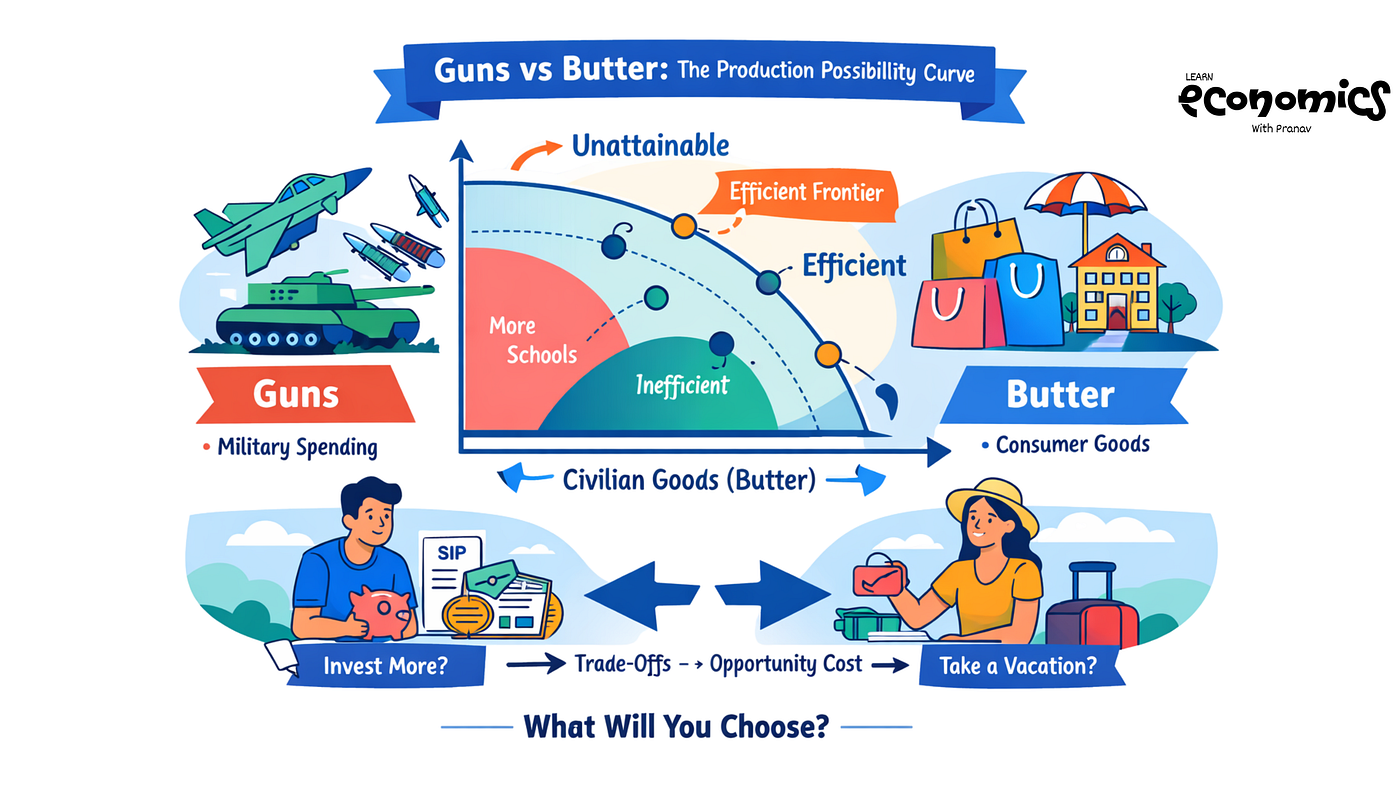
Guns vs Butter: The One Graph That Explains Why Nations Can’t Have It All
Have a great week !