
A divided America benefits “special interest groups”. If “we the people” are divided, our collective voice gets lost and splintered into social, demographic, class and geographic partitions that can be manipulated through social media and electoral maps which can then be controlled and manipulated by highly organized special interest groups (and let’s not forget the politicians willing to go along…) intent on ultimately getting their way.
To support this assertion, consider the following five rhetorical questions and consider them in a world without social platforms such as “X”, Facebook and others:
- Does “America” want billions of its annual taxpayer dollars to go to support free universal healthcare for all citizens of Israel at the same that Israel pursues expansionary and brutal (“genocidal” according to the UN Independent International Commission…) means for pursuing an illegal “greater Israel” and war with Iran where US troops and school children have been killed ?
- Does America want their healthcare, SNAP benefits and other government benefits cut for the purpose of permanently lowering corporate income taxes for these same corporations to then spend their savings on AI, which will eliminate jobs ?
- Did America really want Elon Musk and “DOGE” to tear apart the inner workings of the US government administrative state while also doing what looked like a Nazi salute (and yeah, I’ve heard the counter argument to this and…please…) at a US political rally ?
- Does America really think it’s right that President Trump is becoming a multi-billionaire while in office by trampling the US Constitution while also enriching two of his sons with “sweetheart” government defense contracts when neither son has any experience in the defense industry ?
- Does America support “ICE” whose actions mirror that of other police states such as Nazi Germany in the 1930’s ?
Hall of Fame Movie Director, Frank Capra wouldn’t hesitate to answer all five of the questions posed above with an emphatic, “NO” and his 1941 classic movie, “Meet John Doe” explains why.
Why Frank Capra…right now…
It was while being snowed in during a brutally cold weekend in my early 30’s in a small but cozy apartment located above a bank in quaint and historic “Old New Castle” Delaware that I stumbled onto the final scene of Frank Capra’s classic 1941 movie, “Meet John Doe” attached below.
Watch: final scene from Meet John Doe
Why I was on the verge of tears as I watched this scene, shot on the top deck of a random City Hall, play out between John Willoughby (played beautifully by the legendary Gary Cooper) and D.B. Norton (powerfully portrayed by Edward Arnold), I didn’t know.
For Willoughby, he was there to commit suicide as a final and desperate gesture to warn Americans that the “John Doe Society” concept of local peoples banding together to help each other at a community level during lean times (remember that the Great Depression of the 1930’s didn’t have Social Security, the Affordable Care Act, FDIC Insurance or SNAP benefits…people had to fend for themselves…); while having great intentions, was ultimately a ruse.
While created as a byproduct of a false “story” written to save her career as a reporter, Ann Mitchell had to scramble when her narrative of a despondent anonymous and unemployed man (John Doe) who wanted to commit suicide on Christmas Eve hit a chord with readers. It was then that she had to hire a real “John Doe” to become the national face of local John Doe Societies that were forming all over the country to help people such as what Willoughby was purported to be.
In recognizing the mass appeal of the John Doe movement in conjunction with his monopoly powers as a newspaper tycoon, D.B. Norton saw an opportunity to fulfill his ambitious and amoral political aspirations. Interestingly, the Norton character was modeled specifically on the very real media tycoon of that time, William Randolph Hearst who was an ardent Nazi Germany sympathizer (more on this below) who used his power over the media to support his political view.
When Willoughby found out what was really going on with the movement, he was now the face of, he tried to tell the people at a rally but was silenced by Norton’s henchman while Norton told the crowd that the “lie” was all Willoughby’s fault. The crowd then quickly turned on Willoughby as only a mob can do.
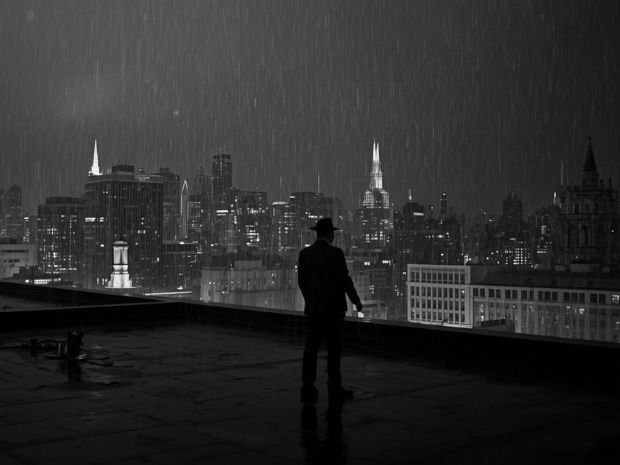
In response, Willoughby was intent on keeping the promise of the original John Doe story going by indeed throwing himself over the ledge of the upper deck of city hall with a letter in his jacket pocket addressed to all future “John Doe’s”…and this is the scene that captured my imagination thirty years ago.
As a viewer, I didn’t know how lucky I was. “Meet John Doe” was being played by a classic movies channel that also provided a narrating host for each of the movies they highlighted. This was before the internet, and it was from this host that I learned not only who Frank Capra was but also the importance of the film for him as a movie director.
Fast forward to today and as I considered what to write about this week, it is the relevance of Capra’s movie, “Meet John Doe” and the iconic scene referenced above that came to mind.
As a people, if we are divided, the D.B. Nortons of the world win. Instead, let’s get off of “X” and other hate focused social media platforms like it to instead look to Albania and its so-called “Flamingo Revolution” as an example of how “the people” can amplify a collective voice to a level that their political leaders have no other choice but to listen to in response.
A Sicilian Immigrant Who Believed in the true American Dream
Frank Capra was born in 1897 in Bisacquino, a small hill town in Sicily and was five years old when his family packed everything they owned and boarded a ship for America. They arrived at Ellis Island in 1903 with almost nothing and settled in Los Angeles where Capra’s father worked as a fruit picker and his mother took in laundry.
By 1938, Frank Capra had won three Academy Awards for Best Director. He was able to do so based on his passion and his experience of knowing that if people worked hard, had a vision and stayed “together” within their family as well as within their community, achieving anything in America was possible.
During the most productive decade of his movie making career in the 1930’s, Capra was also staring at the abject horror of fascist political movements that had taken hold of Europe. Mussolini had taken Italy, the country of his birth, and twisted its civic energy into something monstrous. Hitler had done the same in Germany. And to confront this political tragedy, Capra did what was in his power to do. He made poignant movies that depicted an unshakeable faith he had in ordinary people to eclipse the rottenness of what unchecked political power could do.
Capra also understood with terrible clarity that the forces of monopolistic media, manipulated populism, and a charismatic chief executive who claims to speak for the common man while serving the interests of the powerful and himself first — could take root in America too.
In 1941 he made a film about it…“Meet John Doe”.
D.B. Norton: An American Original
To fully appreciate Capra’s work, one needs to understand who Capra’s D.B. Norton character was modeled on.
William Randolph Hearst built the largest newspaper chain in American history and used it, without apology, as an instrument of personal and political power. He pioneered what came to be called “yellow journalism” — sensationalized, manipulated, emotionally charged coverage designed not to inform but to inflame. He openly supported Adolf Hitler’s rise to power. He used his papers to destroy careers, manufacture public opinion, and intimidate anyone who crossed him.
Hearst was not a secret fascist. He was a public one, operating in plain sight, protected by the very free press principles he was systematically corrupting. The First Amendment, in his hands, became a shield for the monopolistic control of information.
D.B. Norton is Hearst with the mask off. And Capra — the Sicilian immigrant who had watched Mussolini do to Italy what Hearst was doing to American media — understood the connection between monopolistic media control and the rise of authoritarian populism with a clarity that his contemporaries didn’t fully grasp.
Today, there are multiple “Mr. Nortons”
It is regarding today’s manipulated social and mainstream media where Capra’s 1941 “Meet John Doe” vision becomes prophecy.
D.B. Norton had one newspaper chain. He had printing presses, distribution networks, radio stations. His power was enormous by the standards of his time — but it was also visible, locatable, and in principle accountable. You knew where the Bulletin was published. You knew who owned it.
Today’s Mr. Nortons are multiple, global, largely invisible, and operating at a speed and scale that Capra’s imagination could not have reached.
Consider what social media platforms — and X in particular, under its current ownership — have accomplished in the span of just a few years. The John Doe clubs that Capra imagined as gatherings of genuine civic goodness — neighbors talking to neighbors, ordinary people finding common cause across their differences — have been algorithmically replaced by something designed to produce the opposite result. The algorithm does not reward neighborliness. It rewards outrage. It does not amplify what Americans have in common. It instead inflames what divides them. After all, division generates engagement and enraged eyeballs generate revenue.
But unlike Norton, who was one man with one agenda that could in principle be exposed and confronted, the current media landscape features multiple intersecting interests — some domestic, some foreign, some corporate, some ideological — each pulling America’s civic fabric in directions that serve their particular ends while contributing to a general unraveling that serves no one’s long-term interest except those who profit from the chaos itself.
Meanwhile, there is President Trump who understands this political moment and its intersection with human behavior exceedingly well. Accordingly, Trump has portrayed himself as a man of the people in the grand tradition of American populism. He speaks the language of John Doe — the forgotten man, the common American betrayed by coastal elites, the outsider who will fight the system on behalf of those the system has left behind.
But like Norton’s manipulation of the John Doe movement, the question is not whether Trump’s language is emotionally authentic. It’s not, but the more important question is who benefits from the arrangement described above — and who pays.
The special interest groups that orbit and benefit from this administration’s willingness to translate access into policy (and personal cash flow for the Trump family…) include AIPAC’s extraordinary, not for profit and largely unregulated influence over congressional elections and policy, the Christian Right whose political theology has drifted far from its intended civic roots, racial grievance movements that have found in the current political moment a legitimacy they have not enjoyed since the 1920s, and certain Middle Eastern interests whose relationship to American national security is, how do we say ?…complicated.
This is D. B. Norton’s media arrangement as captured by Capra but updated for 2026. The mob that turns on John Doe is not the enemy. The mob is the symptom, and they turned on Willoughby not because they were bad people but because they had been expertly manipulated by someone who understood their fear of being made fools of and weaponized it at precisely the right moment.
Today, there are no evil communists hiding under anyone’s beds. There are only people who are genuinely and legitimately frightened by the pace and scale of the changes transforming their lives — changes in the economy, in technology, in cultural norms, in America’s place in the world — and whose fear is being harvested, refined, and redirected by interests that have no intention of actually addressing the underlying anxiety. To this end,Meet John Doe is not a naive film. Instead, it is a film that looks clearly at how civic goodness can be corrupted, how populism can be weaponized, how the mob can be manufactured — and then insists that people, in the face of great odds, can still persevere for a benevolent outcome if they only stick together.
And here this writer fervently believes, as Capra would, that Americans across every political affiliation have more in common than the current administration, its allied media infrastructure, and the algorithmic architecture of division would have anyone believe. The farmer in rural Ohio and the teacher in urban Philadelphia are not enemies even though the current administration and much of social media says they are. Instead, they are both worried about healthcare, their children’s futures and about a world changing faster than either of them can process. These Americans aren’t enemies, but both are being “worked” to believe they are and instead, should talk to one another.
Frank Capra understood this dynamic in 1941 and made a timeless movie about it. Interestingly, “Meet John Doe” is considered public domain and exists as an American resource. It’s time to put its message to use.
Bottom Line
As an additional exclamation point for this week’s note are two like-minded Substack articles that warrant a read.
Have a great week !