
It wasn’t his promise to make, but he became the famous face of it nonetheless.
Thomas Edward (T.E.) Lawrence, as a British liaison officer, successfully helped lead an audacious Arab Revolt against the much more militarily advanced Turkish Ottoman Empire from 1916 to 1918 during WWI. Lawrence’s job was to organize Arabia’s disparate tribes into a fighting force focused on guerilla military tactics, harassing Turkish armed forces as much as possible in the Mid East in order to neuter the reach of Ottoman forces elsewhere in the region where Great Britain’s military and logistical interests were at stake — most importantly, the Suez Canal.
In return for their valiant and invaluable efforts, the British government explicitly promised — in written correspondence known as the McMahon-Hussein Agreement — Grand Sharif Hussein bin Ali, Emir of Mecca, that Great Britain would recognize and support the independence of an autonomous Arab state encompassing most of the Middle East in exchange for their uprising against the Ottoman Empire. Much was at stake, as depicted in Map 1 below, which provides a high-level view of Mid-East sovereignty as it stood at the start of WWI in 1914.
Beyond the region designated to be under control of “Arab Nomads” in Map 1, the long, narrow reach of the Ottoman Empire down the eastern coast of the Red Sea and the western bank of the Persian Gulf was also up for grabs — assuming the Allied Powers (Great Britain, France, Russia, Italy and Japan) could defeat the Central Powers (Germany, Austria-Hungary, the Ottoman Empire and Bulgaria). The Ottoman Empire had been in decline for centuries following its peak expansion around the 1680s.
Map 1
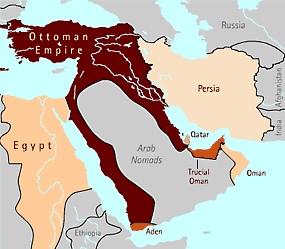
1880 – In the 1700s and 1800s, the once-powerful Ottoman Empire started to lose power. Great Britain, France, and Russia were on the hunt for new territories to conquer and began to interfere in the affairs and territories of the Ottoman Empire and Egypt.
PBS Global Connections: Middle East political maps
At 5 foot 2 inches tall, Lawrence of Arabia was uniquely qualified
As referenced above, Lawrence arrived in the Mid East to “rally” the region against a declining Ottoman Empire. Arabs skeptical of joining the bold plan had every right to be, at least based on first appearances, when they encountered the 5-foot-2 Lawrence. But that skepticism would prove misplaced: despite his diminutive stature, no one else in the world at that time was as ready for this high-wire Mideastern assignment as Lawrence was.
Prior to WWI, Lawrence had spent years studying the Mid East and the ancient “Crusader” castles that still inhabited the land, as part of collegiate studies focused on medieval history and military fortifications. To lend additional credence to his work, in 1909 a 21-year-old Lawrence embarked on a 1,000-mile walking tour through Ottoman Syria and Palestine as a student of modest means — a trip that placed him directly among the Arab people.
Following graduation, Lawrence delved even deeper into the Mid East, becoming an archaeologist at the ancient Hittite site of Carchemish, near the modern-day border between Syria and Turkey. There, Lawrence became responsible for managing a massive workforce of local Arab and Kurdish laborers, which importantly taught him how to lead and motivate Arab men. This experience also made him intimately familiar with Arabic language, tribal customs, clan structures, and regional politics. Beyond people, Lawrence had also become an expert in the region’s topography through his work on the Sinai Survey just before the war. As referenced above, no one in the world was better prepared to lead a military campaign in the Mid East than Lawrence.
Striking parallels and some ironic key differences between the military campaigns of Lawrence of Arabia and the Houthis today
Both Lawrence and the Houthis faced heavily funded, conventionally superior adversaries and, as a result, both became experts in asymmetric warfare to not just to survive, but to thrive. Lawrence avoided head-on battles with the Ottoman army, choosing instead to paralyze the Turks by repeatedly blowing up their vital lifeline, the Hejaz Railway. In similar fashion, the Houthis have demonstrated the ability to consistently rout heavily armed, Western-equipped Saudi and Yemeni government forces using light infantry, pickup trucks, and high-mobility ambushes.
Both Lawrence and the Houthis made topography their ally. Lawrence relied on the vastness of the desert, which he viewed as an “ocean” that let him appear, strike, and vanish before the Ottomans could react. The Houthis today rely on intricate, fortified mountain networks and extensive tunnel systems to survive heavy aerial bombardment from Saudi and Western coalitions.
Patient guerrilla tactics ultimately allowed both the Arab forces fighting with Lawrence and the Houthis today to convert asymmetric warfare into conventional, strategic success against major population centers. Lawrence’s tribal forces eventually captured the important cities of Aqaba and Damascus. The Houthis, meanwhile, began as a localized mountain militia but have since executed what amounts to a state-capture campaign, seizing Sana’a and the shoreline of the critical Red Sea coast.
While the parallels are striking, there is one equally striking difference. Over a century ago, Lawrence acted as an agent of Great Britain — a Western superpower — to fragment the long-entrenched Ottoman Empire. The Houthis, by contrast, operate in direct opposition to Western alignment. They are backed by Iran as a core component of an “Axis of Resistance” that draws on religious and anti-imperialist sentiment to fight Western-backed regional powers like Saudi Arabia.
Beyond the surprise US-Iran war earlier this year, deeper reasons exist for broader Mideastern antipathy toward the West. Some of these reasons trace directly back to what Great Britain did immediately after WWI. Despite the Arab nations winning their independence by taking Damascus and earning Lawrence the title of “Lawrence of Arabia” provided by a journalist covering his exploits in the war, Great Britain still broke its promise of sovereign independence and then did something even worse.
A broken promise
When Lawrence arrived in the Mid East in 1916, it was the second year of a devastating world war whose scale no sovereign leader had foreseen, in terms of both human loss and cost. Of WWI’s seven theaters, the Western Front was the deadliest. There, in 1916 alone, the horrific battles of Verdun and the Somme were fought. Verdun lasted over 300 days and ended in stalemate, with more than 700,000 casualties. The Somme was fought over five months and cost over a million casualties in another stalemate, which was intended to relieve pressure on Verdun. Beyond the staggering loss of life, WWI would eventually cost Great Britain the equivalent of over $35 billion in today’s dollars, a colossal sum for the time.
Mapping History (University of Oregon): The costs of World War I
The point of dwelling on the scale and cost of WWI is to emphasize the seismic pressure it placed on governments which also meant pressure that Britain’s promise to the Arab nations was unlikely to be kept even as the promise was being made. As a result, there was no time for Lawrence to celebrate this historic military accomplishment when he and the Arab tribes stormed into Damascus in 1918.
Instead, Lawrence grew deeply disillusioned when he learned the details of the secret Sykes-Picot Agreement, finalized behind his back during the Arab Uprising. Beyond its secrecy and the broken promise it represented, Sykes-Picot divided the Middle East into colonial spheres of influence which was the exact opposite of the Arab independence that had been promised, as depicted in Map 2 below.
Map 2
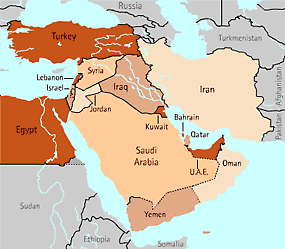
2002 – These are the current internationally recognized boundaries in the Middle East. Disputed boundaries are indicated with a dotted line.
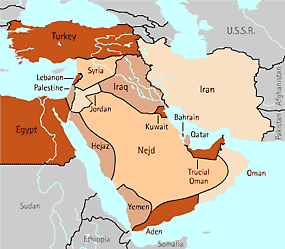
1920 – In 1919, the British and French implemented the 1916 Sykes-Picot Agreement and divided the Arab world into nation-states. The League of Nations recognized these borders and allotted “mandates” to the French and British to govern these states until it was determined that they were ready for independence.
PBS Global Connections: Middle East political maps
Beyond being a breach of trust of the highest order, the arrogance of the agreement became even more apparent once it was widely known that Sir Mark Sykes and François Georges-Picot had used colored pencils to divide the region into spheres of influence and took no regard for ethnic, tribal, or religious diversity of the people residing within these uninformed yet precise boundaries. For good reason, this flippant redrawing of the Mid East map over a century ago remains a root cause of the instability that still haunts the region today.
Bottom Line
Back in 1918, Western powers were technically and militarily light-years ahead of the Mid East and could dictate terms unilaterally, as they did with Sykes-Picot. Today, as a result of the US-Israeli war with Iran, those dynamics have shifted radically.
Interestingly, against this backdrop, the writer had decided last week to write about Lawrence of Arabia and the long-term damage done to the Middle East by the broken promise of the Arab Revolt as I came across “What’s After Hormuz: The Iran War, the End of Sykes-Picot Gulf Statelets, and American Order in West Asia,” published on Substack on September 18th. It offers an almost perfect segue connecting today’s mess in the Mid East back to the time of Lawrence of Arabia.
From the article:
“…President Donald Trump has told Axios he faces “a big decision” about whether to “annihilate” the Iranian government, and he plans to meet the leaders of Saudi Arabia, the United Arab Emirates, Qatar, Bahrain, Kuwait and Oman at the United Nations on 22 September to “find out where they are and how they are doing.” He added that Washington has been “very protective of them.”
That sentence is the heart of the crisis. For half a century the political economy of the Arabian Peninsula rested on a bargain: the Persian Gulf monarchies sold oil and gas to the world and hosted American power; the United States guaranteed the thrones, the shipping lanes, and the price of insurance. The 2026 war has not abolished those states. It has broken the assumption that the bargain still works.
The question now asked in Riyadh, Abu Dhabi, Doha, Manama, Kuwait City and Muscat is not whether the flags still fly. It is whether the order that made those flags solvent—cheap security, uncontested export routes, and an external great power willing to bleed for the strait—survives the first serious test of the missile age.”
Beyond the fluid debate over what to do with American involvement in the region from here, the article also explores the diverse profiles of the countries that make up the Mid East as a direct result of Sykes-Picot. It also discusses the Mideastern countries that were not created by that flawed colonial arrangement but instead were molded during a century of gunboat diplomacy with Great Britain where “the Trucial sheikhs, Bahrain, and later Qatar” signed up for British protection of their sea lanes to India. Kuwait signed on for this same arrangement in 1899. Oman’s relationship with Britain, meanwhile, ran on a separate treaty track dating from the early nineteenth century.
Through this lens, Saudi Arabia, the region’s ultimate power broker, alongside wealthy coastal states with breathtaking skylines like Dubai, Doha and Abu Dhabi, stands out as having a fatal flaw:
Saudi Arabia was “not a League of Nations mandate. It was a conquest state that then signed oil concessions with American companies and, after 1945, a security relationship with Washington.” “…Peninsula states that became rich after oil were not self-sufficient security producers. They were clients first of the Pax Britannica and then of the Pax Americana. When Britain announced in 1968 that it would leave ‘east of Suez,’ and when the last treaties lapsed in 1971…” the US stepped into to fill that “patronage” void.
It is now, with the visible vulnerability of a US military model that can now no longer project the power it could even at the start of this year, that the title of the above referenced article proves a fitting conclusion to this discussion as it speaks to a secular shift poised to alter the future trajectory of the Mid East.
Final Thoughts
Against this backdrop sits an uncomfortable reality for the US. The current US setback in Iran effectively ends a period of “Pax Americana” across the Mid East, in which American “protection” was paid for, in part, through foreign purchases of US Treasuries. That has two implications. First, higher US rates are likely here to stay. Second, to the extent the US is slow to accept this new reality and oil supplies remain constrained, energy importers such as Japan face an inflation problem. Of particular interest for a country like Japan, which, according to Gemini, has exported roughly $2.5 to $3.5 trillion of capital to the West over the past 20 years is that this flow of money may not only dry up, but could also be repatriated back to Japan at an inopportune moment as American “exceptionalism” is being questioned on the global stage.
Against this backdrop, the writer remains defensively invested even in the wake of the equity market strength seen on Monday, September 21st. This posture includes 20% cash, a healthy allocation to T. Rowe Price Bank Loans, and a more measured allocation to Chinese equities via the T. Rowe Price China Evolution Fund, which is comprised of small- to mid-cap “A” shares with an attractive correlation profile relative to broader equity markets that have become unduly concentrated due to the frenetic buildout of domestic AI capabilities. These positions are complemented by a relatively concentrated set of stocks chosen at a desired intersection where valuation, fundamentals and outlook meet.
And just before closing, the writer can’t help but speculate about what an increasingly desperate, unpredictable, and largely “immune” President Trump is capable of in this moment. It’s against this backdrop that yesterday’s Wall Street Journal article, “In Trump, Xi Sees ‘Rare Window’ to Convince Taiwan that Resistance is Futile,” feels apt; the title says it all.
Next week, Xi Jinping and Trump meet in a high-stakes summit where Xi arguably holds the stronger hand which raises the question: would Trump give up Taiwan, in some transitional way, in exchange for China’s help finding a way out of the Iran war while still saving face? (Taiwan already doesn’t fully trust Trump.) If this prognostication seems far-fetched, consider that the US is also planning to source more of its potash, at a greater expense, from Belarus, a close Russian ally, seemingly just to make a geopolitical point aimed at Canada’s Mark Carney.
In the 1991 film Star Trek VI: The Undiscovered Country, Spock observes that “only Nixon could go to China.” Trump is a well-documented admirer of Nixon — and maybe only he can pull off a historic deal of his own, one that would define his legacy in his own mind. To be clear, the writer views this as a horrible idea, but also one that this writer would also not put past Trump. As an aside, this writer is not invested in semiconductor sector stocks at this time.
Have a great week.