
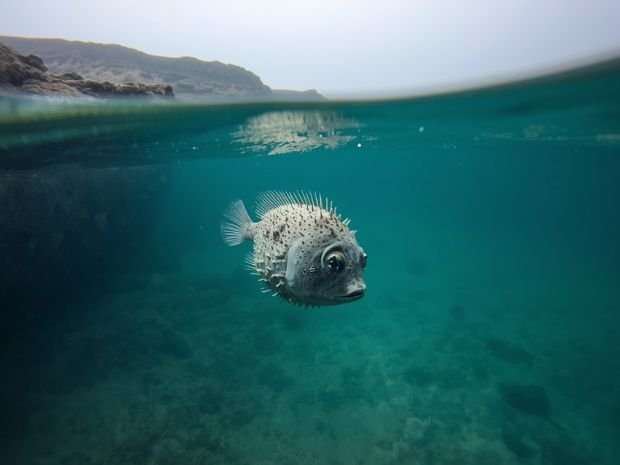
The writer made the mistake of letting a friend, we’re not in touch anymore , talk me into going on an offshore boating trip decades ago to fish for tuna off the coast of Ocean City, Maryland even though I don’t fish. Not many fish were caught that day which magnified the importance of the blowfish that I actually was able to catch (I released it back…) and was relentlessly made fun of for. Some people, I learned that day, take their Tuna fishing a little too seriously and I never forgot the experience which also made me think that blowfish were a lower class of fish. I couldn’t have been more wrong.
Blowfish, as it turns out, are a worthy fish and metaphorically have a strong connection to the Houthis in Yemen, who arrived on the geopolitical scene, from a Western perspective, with a bang last week by capturing the increasingly important Bab el Mandeb Strait that connects the Red Sea with the Gulf of Aden and the Indian Ocean. While small and historically isolated, both the Houthis and Blowfish utilize unique defense mechanisms, unexpected inflation, and latent toxicity to deter much larger predators as explained by Gemini below.
1. Radical Inflation as a Defense Mechanism
- The Blowfish: When threatened, a blowfish ingests massive amounts of water or air to swell up to several times its normal size, transforming from an easy meal into a spiked, unswallowable sphere.
- The Houthis: Historically a localized insurgent group in northern Yemen, the Houthis rapidly inflated their regional presence and global profile. By launching drone and missile attacks on international shipping lanes in the Red Sea and targeting major global powers, they expanded their geopolitical footprint far beyond their actual geographic or economic weight. This, they made themselves appear too “prickly” and difficult for superpowers to easily eliminate without catastrophic effort.
2. Lethal Toxicity Hidden in a Small Package
- The Blowfish: The pufferfish contains tetrodotoxin, a substance deadlier than cyanide. It does not need a massive physical stature to be lethal; its toxicity is a complete deterrent.
- The Houthis: Despite operating from a war-torn, impoverished nation, the Houthis possess a highly lethal, asymmetric arsenal. Utilizing low-cost drones, anti-ship ballistic missiles, and sea mines (often supplied or facilitated by Iran), they wield a “toxic” capability that can paralyze global trade routes, inflict billions of dollars in economic damage, and threaten advanced naval warships.
3. Asymmetric Defiance of Superior Predators
- The Blowfish: A shark or larger fish can easily overpower a deflated pufferfish. However, once the pufferfish inflates, attempting to swallow it can choke or poison the predator.
- The Houthis: In a conventional military matchup, a coalition of Western or regional superpowers vastly outmatches the Houthis. However, the Houthis rely on this exact asymmetry. By embedding themselves within a deeply complex terrain and using cheap, distributed weaponry, they challenge “predators” to swallow them—knowing that a full military occupation or prolonged campaign would be incredibly costly, messy, and politically choking for an outside power.
4. The Danger of the “Post-Inflation” Reality
- The Blowfish: Inflating is exhausting and stressful for the pufferfish; it is a temporary survival state, not a sustainable way to swim.
- The Houthis: The rapid expansion of Houthi influence has come at the cost of severe domestic strain, a humanitarian crisis in Yemen, and complete economic isolation. While their inflated military posture projects strength outward, the internal governance and long-term sustainability of the territory they control remain fragile and strained.
It is in terms of trying to simplify the fluid complex geopolitics of the Mid East in conjunction with an attempt to make a clever reference to the US rock band Hootie and the Blowfish that the metaphor above works. Importantly, the metaphor in no uncertain way is intended as any form of disrespect to the gravity of events taking place in the Mid East or to diminish in any way the humanitarian tragedy involved in the region. Instead, the creativity embedded in the title of this article is intended instead to draw as many eyeballs to this story as possible.
Among many reasons for the alarm cited above is that with Iran holding the upper hand in its war with the US and Israel so far, the Trump administration just “greenlit” a $2.8 billion arms sale of controversial “one ton” bombs to Israel. Such bombs are known to have a wide blast zone and represent high risk to civilians when they are deployed in heavily populated areas. And given United Nations findings of Israel conducting genocide in Gaza, the optics of this transaction are less than ideal from a US perspective as the Mid East, sparked by the Houthis, appears to be galvanizing around the idea of supporting Palestine in its struggle with Israel. More on this below.
Iran can now impact $10 billion of daily commerce for the global economy
As if out of nowhere (from a Western perspective…), the Houthis, a close ally of Iran, introduced additional and material complexities to the US and Israeli War with Iran when it captured the strategic port city of Mocha in southwestern Yemen. This gave the Houthis control over the entire west coast of Yemen, including, as referenced above, the Bab al-Mandeb Strait, the narrow passage that connects the Gulf of Aden to the Red Sea. As illustrated in the two maps below, this breakthrough by the Houthis in conjunction with Iran still being able to materially constrict the flow of commerce flowing through the Strait of Hormuz also means that Iran now has a large degree of control over two vital maritime chokepoints that now put an estimated $10 billion per day in global trade at risk.
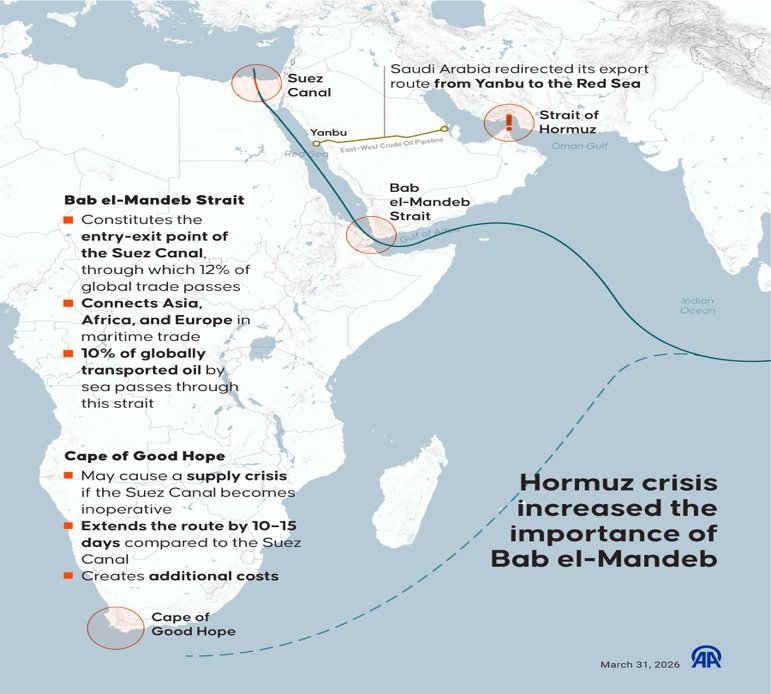
Anadolu Agency: Bab el-Mandeb Strait infographic
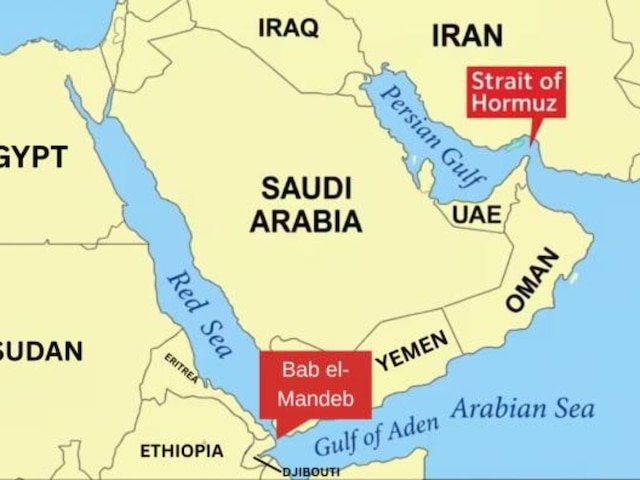
DNA India: Iran, Bab el-Mandeb, Strait of Hormuz and global oil shipping explained
The audacity of the developments referenced above cannot be overstated. While Iran has been considered as a regional power in the Middle East for decades before its recent war with the US and Israel, this surprise conflict, Iran’s readiness and effectiveness in navigating it so far, have powerfully transformed this theocratic Islamic republic into a higher dimension of relevance.
And with much of the difficulty for the US war with Iran only now becoming more widely recognized as events such as those referenced above are now so material from a global perspective that they can’t be ignored (such as the destruction of US military bases across the Mid East which raises questions around the staying power of the US Navy in the Mid-East) …even with US censorship of its press under the Trump administration. As a result, it is through a lens of shock that US and Israeli military prowess being unexpectedly stymied in the Mid East that reminds the writer of the awe experienced by many when “overnight sensations”, such as the meteoric rise of the rock group, “The Beatles”, in the early 1960’s, suddenly appear on the scene.
Lessons from “The Beatles” that relate to the Mid-East
As explained in Malcolm Gladwell’s 2008 book, “Outliers: The Story of Success”, sudden and “overnight sensations” are a myth. Before the Beatles set foot in the United States for the first time in 1964, for example, while they didn’t look it; they were actually “grizzled” veterans” of delivering live music performances thanks to the arduous performing schedule the band endured in Germany for years before coming to America. In Germany, the Beatles played live performances that sometimes ran 7 to 8 straight hours a night, that aggregated to about 1,100 hours of incessant playing during 1961 into 1964 just before coming to America. Throw in that the Beatles were enormously talented resilient musicians who were close friends along with the “street cred” they had gained in Germany and the “British Invasion” in 1960’s US music, sparked by the Beatles, can be better understood.
It is through such a context of looking beyond the face value of current remarkable events unfolding in the Mid East to also delve more deeply into their root causes that now warrants attention. Within this context, let’s consider Iran and roll the clock back 25 years to 9/11. In response to the unprecedented and tragic terrorist attack on the US, President Bush declared a global war on terror. This action precipitated US invasions into Afghanistan in 2001 for the pursuit of al-Qaeda (and inevitably, the Taliban, who governed the region) and Iraq in 2003 for the additional chase for weapons of mass destruction that served as a justification to topple the regime of Saddam Hussein in Iraq.
In asking Gemini if the US had much to show for the two invasions referenced above, the following response from AI was curt, “The short answer is…not much that aligns with their original strategic goals-and at a staggering human and financial cost.” The Council of Foreign Affairs went further in their assessment that the “post 9/11 invasions of Afghanistan and Iraq as having failed to achieve their grand ambitions, leaving behind a legacy of instability, immense debt and shattered regions rather than stable pro-Western democracies.” Said differently, the two US wars above created a tinder box in the Mid-East that is proving to be enormously difficult for the Trump administration to navigate today.
A more damning reality regarding the two US invasions referenced above were the results. The Taliban ultimately regained governing control of Afghanistan despite being temporarily displaced by American forces while Iraq ended up with a fragile political ecosystem that is now heavily influenced by Iran. Both outcomes were the exact opposite of what the US hoped for in terms of invasion objectives. Worse yet, these actions destroyed two of Iran’s largest regional enemies which created an enormous power vacuum in the region that Iran has deftly been able to fill. To do so, Iran created a formidable network of proxy allies from the bottom up that includes Hezbollah in Lebanon, the Houthis in Yemen, Hamas as well as Shia militias in Iraq and Syria. Iran also covered its theoretical geopolitical flanks from a top-down perspective by tightening its ties with global heavyweights in the form of China and Russia.
Beyond effective geopolitical positioning, Iran also became a good student of the US approach to war by watching the superpower operate in two Gulf wars. Iran’s “mosaic defense strategy”, for example, that emphasizes a decentralized military structure specifically designed to withstand a “decapitation strike” to its leadership by having 31 autonomous provincial commands that can keep fighting independently was created specifically to combat US military strategy observed during the second Iraq war. It was this specific stratagem that saved Iran when 40 (this number climbed to 50 by the end of the first month of the war…) of its senior officials were killed in the opening hours of the conflict.
Iran additionally developed an understanding of US missile technology and how it was deployed in the second Gulf War which allowed the Iran to devise a strategy to combat it with an array of abundant cheaper alternatives designed to confuse and overwhelm US systems and an overall American approach that arguably hasn’t evolved much since the turn of the century.
The point in chronicling and analyzing through recent Mideastern history is to highlight the reality that US and Israeli military difficulty with toppling Iran this year should not represent a surprise after deeply reviewing the facts surrounding the conflict. Similarly, the sudden and unexpected rise of the Houthis from a Western perspective in recent weeks is anything but sudden and unexpected upon a review of this same history. To this end, let’s now turn to the Houthi’s and their remarkable story of resilience and growth this century.
The Rise of the Houthis
The Houthis also known as Ansar Allah was first started by Hussein Badreddin al-Houthi as a small religious group that grew out of an educational and religious revivalist organization known as the “Believing Youth” that promoted “Zaydism”, a branch of Shia Muslim with deep roots in Islamic history. Beyond the spiritual realm, the “Houthis” also stood against what it perceived as a rising Saudi backed Sunni/Salaf in northern Yemen as well as corruption of then Yemen President Ali Abdullah Saleh that also largely tied back to Saudi Arabia.
It was then in the wake of the 2003 US invasion in Iraq that the Houthis transformed from its political/religious roots referenced above into a hardline political and armed insurgency group in Yemen that stood against US and Saudi Arabia influence over their region. In 2004, anti-government protests in Saada led by Zaydi groups turned into a full-blown insurgency when the Yemeni government under Saleh tried to arrest al-Houthi himself and then turned him into a martyr when full blown hostilities erupted between Yemen government forces led by Saleh and the Houthis. Six years of civil war with Yemen followed and into this already existing chaos emerged the additionally destabilizing Arab Spring of 2011.
Within this heightened state of Mid-Eastern destabilization, kick started by the US invasion of Iraq in 2003, that the Houthis proved adept in navigating that ultimately allowed the group to overrun the capital of Yemen and its governing apparatus in 2014. It was then that growing Houthi influence and its anti-US and Saudi stance that served as a catalyst for a Saudi Arabia led military coalition to counter the rising Houthi movement in Yemen sparking a civil war. An extended military clash between the Saudis and Houthis ensued along with a related humanitarian crisis in Yemen that was temporarily abated with a tenuous truce between the Houthis and Saudi Arabia in 2022.
But since 2022, under the cover of “peace”, the Houthis deepened military and strategic ties with Iran, Hezbollah and Hamas. And in conjunction with this strengthened underground regional network, the Houthis then seized on the new chaos in the Mid East region, created by the so far unsuccessful US and Israel war with Iran, to execute a lightning advance along Yemen’s Red Sea coast to seize control of the Bab el-Mandab Strait which then threatens commerce, specifically Saudi Arabian related oil (35% to 40% of total oil production in the Mid East), trying to navigate the narrow yet vital waterway.
Hearts and Minds of the Mid-East
Away from the escalation of military pressure building in the Mid East right now is an even more important and too often overlooked story, which relates to the “hearts and minds” of people in the region. This consideration matters greatly as it did in Vietnam in the 1960’s where a unified people with a single-minded determinedness to achieve sovereign independence was able to defeat the most powerful military in the world in the 1960’s. In similar fashion to the vision offered by Ho Chi Minh to rally the Vietnamese around their cause, so too the Houthis offer a unique value proposition to the vast peoples (approximately 500 million) that inhabit the Mid East region.
For decades, according to the Brookings Institute, many Arab populations, for example, have felt frustrated by the perceived inaction of their own governments regarding the ongoing Israeli Palestinian conflict. The Houthis have been able to capitalize on this anger with action.
Consider that beyond diplomatic statements of condemnation from other nations typically followed by a “blind eye”, the Houthis have been able to launch actual drone strikes against Israel. This action has been accepted as a seeming rallying cry across Islam in the Mid East to collectively move against the interests of wealthy nations (the US, Israel, the UK, Saudi Arabia and the UAE) seen to be exploiting the Mid East while also standing against Israel’s ambitions for a “Greater Israel” project that condones genocide in Gaza according to the United Nations.
Beyond the considerations referenced above, the Houthis have earned respect in the Mid-East. Consider, for example, that despite being from one of the poorest countries in the world, the Houthis, were able to fight a massive military campaign against well-funded and armed Saudi Arabia and UAE forces over 10 years to then force Saudi Arabia to the negotiating table. This effectively meant that the Houthis won the Yemeni civil war.
Before leaving the topic of “Hearts and Minds”, the attached clip of Professor Seyed Marandi, a former advisor to Iran’s Nuclear Negotiation team (the writer started listening to Professor Marandi last spring and found that most of his guidance on the war in Iran back then has proven to be mostly true…) where he walks through the unique dynamics playing out in the Mid-East is worth a view and most specifically at around the 18 minute mark. It is here where Professor Marandi speaks to the specific appeal of the Houthis who are increasingly viewed as heroes in the region for their actions in trying to stop Israeli genocide of Palestinian people as has been confirmed by the United Nations and other human rights organizations since 2023.
Substack: Professor Seyed Marandi on Mid-East dynamics and the Houthis
How drone warfare factors into the rise of the Houthis
Of additional interest within the Houthi story is the concurrent rise of drone warfare that has levelled the geopolitical playing field in recent years which is a trend that has been accelerated due to Ukraine’s war with Russia. In balancing the intangible importance of “hearts and minds” at a people level with the practical need for weapons in a conflict, the writer queried Gemini as to whether the dramatic rise of the Houthis would have been possible without the ascent of cheap drone warfare ? to learn:
“Yes, the political and military rise of the Houthis would have been possible without drone technology as the group consolidated their domestic power in Yemen the old-fashioned way through fierce tribal alliances, religious ideology and a weak fragmented central government. But interestingly, the emergence of cheap, long-range drone technology-heavily catalyzed by Iranian technical transfers and mirrored by tactics seen in Ukraine is what allowed a regional rebel group to project force globally by disrupting international commerce.”
Bottom Line
As has been the case for weeks, the writer, for reasons additionally articulated above, expects war in Iran to escalate. This leaves higher oil prices, higher inflation (the Fed vote to raise rates yesterday was unanimous…), higher global interest rates, and ultimately heightened equity market volatility for the foreseeable future. And away from what can often be erroneous prognostication of future oil prices, let’s instead consider that WTI oil began the year at $57 and now resides at $102. And while higher rates are serving to punish gold prices near term, the destabilizing nature of everything described above makes the precious metal’s near-term price weakness an investment opportunity.
Beyond everything referenced above is a closing reminder that the Trump administration is fast tracking the sale of $2.8 billion of 2,000 pound bombs to Israel. The bombs are controversial in that they are highly lethal when use on concentrated civilian urban populations and are being provided to a country, who according to the United Nations and other reputable sources, is conducting genocide in Gaza as part of its Greater Israel project. The justification for this Israeli initiative for some Zionists is a holy war as its primary justification is based on biblical verses from thousands of years ago, which warrants credulity in a world with established secular international law that has evolved since the Peace of Westphalia that ended the Thirty Years War in 1648. Away from all of the turmoil referenced above thankfully is one ultimate arbiter which is history. It is always watching…
Have a great week.